Diana Staubli
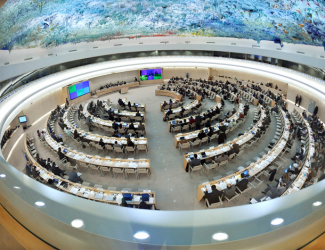
The Human Rights Council (HRC) is the key intergovernmental body within the United Nations system responsible for the promotion and protection of all human rights around the globe. It holds three regular sessions a year: in March, June and September. The Office of the UN High Commissioner for Human Rights (OHCHR) is the secretariat for the HRC.
Debating and passing resolutions on global human rights issues and human rights situations in particular countries
Examining complaints from victims of human rights violations or activist organizations on behalf of victims of human rights violations
Appointing independent experts (known as “Special Procedures”) to review human rights violations in specific countries and examine and further global human rights issues
Engaging in discussions with experts and governments on human rights issues
Assessing the human rights records of all UN Member States every four and a half years through the Universal Periodic Review
AWID works with feminist, progressive and human rights partners to share key knowledge, convene civil society dialogues and events, and influence negotiations and outcomes of the session.
Si por algún motivo deseas que retiremos y borremos tus respuestas, tienes todo el derecho a hacerlo. Puedes contactarnos a través del formulario disponible aquí indicando «Encuesta WITM (¿Dónde está el dinero?) » en el título del mensaje, y procederemos a retirar y borrar tu respuesta.
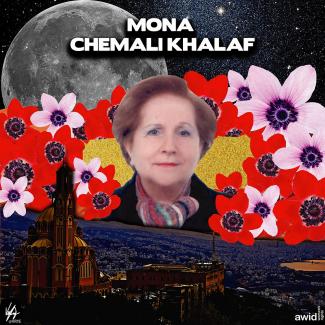
Mona fue una economista y consultora independiente sobre temas de género y desarrollo.
Fue profesora de economía y Directora del Institute for Women's Studies in the Arab World de la Lebanese American University. Falleció repentinamente el 6 de enero de 2018.
Sus amigxs y ex-colegas dicen sobre Mona: «Cuando celebramos su vida, lo mejor que podemos hacer es comprometernos a continuar con lo que ella empezó: la igualdad de género, indefectiblemente.
El Foro de AWID siempre ha sido un espacio que no elude las conversaciones difíciles y muy necesarias. Aceptaremos estas propuestas si lxs organizadorxs pueden garantizar un espacio respetuoso y seguro para quienes participen.
Photos de Mariam Mekiwi
Conceptrice de costume et modèle : El Nemrah
Oui, n’hésitez pas à le faire! Nous vous encourageons à communiquer le lien vers l’enquête à vos réseaux. Plus les points de vue exprimés et collectés seront divers, plus notre compréhension du paysage du financement de l’organisation des mouvements féministes sera exhaustive.
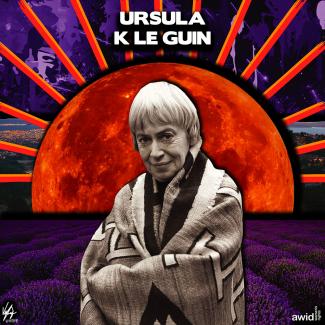
Ursula était une romancière américaine dont les genres littéraires de prédilection étaient la science-fiction et le genre fantastique.
Elle a connu le succès grâce à son roman « La main gauche de la nuit », où elle imagine une société du futur où les personnes sont ambisexuelles - leur sexe n’est pas déterminé. Parmi les premiers grands livres de science-fiction féministes, ce roman explore les influences du genre et du sexe dans la société. Ursula était une source d'inspiration pour ses écrits subversifs et originaux, ainsi que pour les thèmes du féminisme et de la liberté qui lui tenaient tellement à cœur.
En 1983, lors d'un discours au Mills College en Californie, elle a déclaré aux diplômé-e-s : « Pourquoi une femme libre ayant suivi une formation universitaire devrait-elle combattre Macho-Man ou le servir ? Pourquoi devrait-elle vivre sa vie selon son bon vouloir ? J'espère que vous vivrez sans avoir besoin de dominer et sans avoir besoin d'être dominé-e ».
Lo que me ayudó fue que me gustó mucho la tarea de andar por el país y documentar lo que la gente sabía. Entonces, dejé la comodidad de lado...



لمشاركة تجاربكم/ن المعاشة بما يتعلق بتمويل منظمتكم/ن
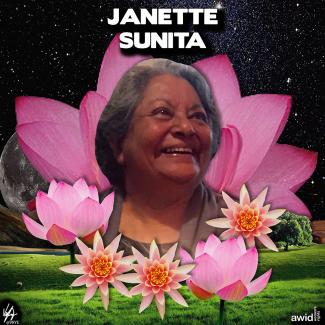
From India, Janette was feisty, formidable, compassionate and loving.
Janette’s intolerance of injustice and fierce commitment to standing up for all people’s rights led her to work at TARSHI (an NGO that works on sexuality and sexual and reproductive health and rights) for more than 15 years. Janette ably managed and led the finance, human resources and operations aspects of TARSHI’s work, adeptly navigating the labyrinthine bureaucracy to which Indian NGOs are subjected.
Her team remembers that “She stood watch so we could steer well in open waters. A woman of many talents, Janette not only helped us procure our own office space but also designed it for optimal usage.She loved travel and animals and was interested in animal assisted therapy."
« Pour moi, ce genre de discussion compte parmi les expressions d’amour dont la vie me permettait de profiter depuis peu. Je ne savais pas que cette autre forme d’amour – que l’on trouve en dehors d’ateliers de formation, d’espaces d’activisme, de classes ou de lieux de travail – était possible... »

الاستطلاع متاح باللغات العربية، الإنجليزية، الفرنسية، البرتغالية، الروسية والاسبانية!
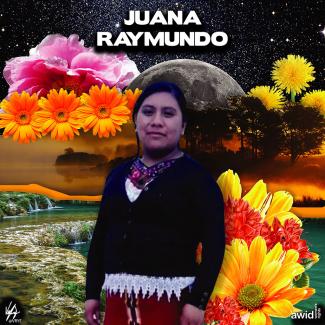
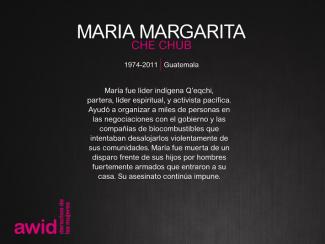
Juana fue una indígena maya ixil, enfermera profesional y coordinadora del Comité de Desarrollo Campesino – CODECA de la microrregión de Nebaj Quiché.
El comité es una organización de derechos humanos formada por granjerxs indígenas dedicada a promover los derechos sobre la tierra y el desarrollo rural para las familias indígenas. Inicialmente, Juana se unió a CODECA como integrante de su rama juvenil, la Juventud de CODECA. Al momento de su muerte, había sido elegida para ser parte del Comité Ejecutivo del Movimiento de Liberación de los Pueblos (MLP).
Su cuerpo fue encontrado por lxs vecinxs, junto a un pequeño río en el camino cerca de Nebaj y Villa Acambalam, en Guatemala. Según CODECA, el cuerpo de Juana mostraba signos de tortura.