Jean-Marc Ferré | Flickr (CC BY-NC-ND 2.0)
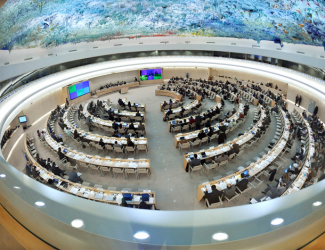
A general view of participants at the 16th session of the Human Rights Council in Geneva, Switzerland.

Human Rights Council (HRC)

The Human Rights Council (HRC) is the key intergovernmental body within the United Nations system responsible for the promotion and protection of all human rights around the globe. It holds three regular sessions a year: in March, June and September. The Office of the UN High Commissioner for Human Rights (OHCHR) is the secretariat for the HRC.

The HRC works by:

  • Debating and passing resolutions on global human rights issues and human rights situations in particular countries

  • Examining complaints from victims of human rights violations or activist organizations on behalf of victims of human rights violations

  • Appointing independent experts (known as “Special Procedures”) to review human rights violations in specific countries and examine and further global human rights issues

  • Engaging in discussions with experts and governments on human rights issues

  • Assessing the human rights records of all UN Member States every four and a half years through the Universal Periodic Review

Learn more about the HRC


AWID works with feminist, progressive and human rights partners to share key knowledge, convene civil society dialogues and events, and influence negotiations and outcomes of the session.

With our partners, our work will:

◾️ Monitor, track and analyze anti-rights actors, discourses and strategies and their impact on resolutions

◾️ Raise awareness of the findings of the 2017 and 2021 OURs Trends Reports.

◾️Support the work of feminist UN experts in the face of backlash and pressure

◾️Advocate for state accountability
 
◾️ Work with feminist movements and civil society organizations to advance rights related to gender and sexuality.
 

Related Content

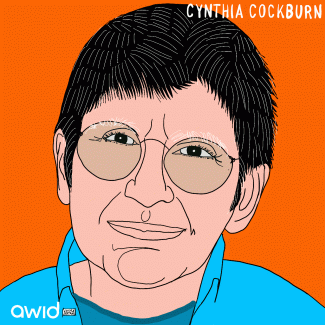
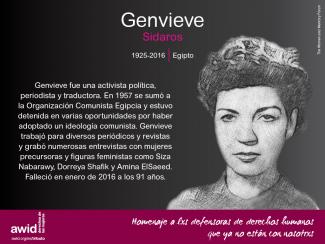
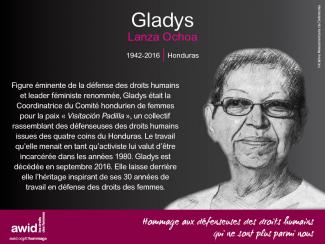
Cynthia Cockburn

Cynthia Cockburn was a feminist sociologist, writer, academic, photographer and peace activist.

She explored the gendered aspects of violence and conflict and made significant contributions to the peace movement through her exploration of the themes of masculinity and violence as well as her local and international activism.

Cynthia brought a feminist power analysis to militarisation and war, and was among the academics whose writings and analysis clearly demonstrated how gender-based violence played a key part in perpetuating war. Working closely with peace activists in countries experiencing conflict, her findings covered diverse contexts including Northern Ireland, Bosnia-Herzegovina, Israel/Palestine, South Korea, Japan, Spain and the UK. She helped bring in her research and academic writings, an understanding that violence was experienced as a continuum of time and scale and perceived very differently when seen from a gendered lens.

In her words, “Gender helps us to see the continuity, the connection between instances of violence.” 

Cynthia bridged her research with the activism she did locally and internationally with movements for demilitarisation, disarmament and peace. She helped start the Greenham Common women’s peace camp, which advocated for universal nuclear disarmament in Britain and was part of establishing the London chapter of Women in Black.

Over the decades, Cynthia organized and participated in local weekly vigils and the political choir Raised Voices, singing in the choir, and writing several of the lyrics to the songs that have made up its repertoire. She was also active in the Women’s International League for Peace and Freedom (WILPF), the European Forum of Socialist Feminists as well as in Women Against Fundamentalism.

“Cynthia shed feminist light, wove together feminist communities, sang songs of peace, listened, listened, listened, watched the birds – and stopped traffic. I’ll be forever and gratefully in her debt, the other ‘Cynthia’” – Cynthia Enloe

Cynthia was born in July 1934 and passed away in September 2019 at the age of 85.

Snippet - COP30 - Resistance Hubs Section Column 1 - ES

Mientras les líderes se reúnen en Brasil, es fundamental que los movimientos feministas, sobre todo los de la mayoría global, contemos con espacios autónomos para encontrarnos, elaborar estrategias y trastocar.

En estos nodos interpelamos el elitismo de las conversaciones sobre el clima, nos centramos en las vivencias y apuntamos a construir el poder colectivo más allá de las fronteras. Se ofrece un contrapeso crítico a las negociaciones internacionales jerárquicas y a menudo excluyentes. En los nodos buscamos promover las soluciones nacidas de la comunidad, amplificar las demandas feministas y garantizar que los principios feministas de los cuidados y la solidaridad sean los que den forma a la agenda por el clima. No se trata únicamente de tener presencia en la COP30, se trata también de reconfigurar las conversaciones sobre la justicia climática en términos feministas.

6. Menez une recherche documentaire

La recherche documentaire peut se dérouler tout au long de votre initiative. Elle peut vous aider à encadrer vos travaux, à choisir des questions de sondage et à comprendre vos résultats.

Dans cette section

Préciser le contexte

La réalisation de recherches documentaires tout au long de votre initiative peut vous aider à encadrer vos travaux, à choisir les questions de sondage et à vous fournir une clarté contextuelle, tout en rehaussant votre compréhension des résultats de votre sondage. Vous pourriez notamment comparer les similarités et les différences entre les résultats de votre sondage et l’information diffusée par la société civile et les donateurs.

Il se peut que vous déceliez des tendances dans les résultats de votre sondage et que vous souhaitiez mieux les comprendre.

Par exemple, vos données de sondage pourraient révéler que les budgets des organisations diminuent, mais cela ne vous dit pas pour quelle raison cette situation se produit. L’analyse des publications vous donne un contexte et vous révèle certaines des raisons pour lesquelles ces tendances surviennent.

Haut de page


Exploiter les connaissances existantes

La recherche documentaire garantit également que vous appuyez votre recherche sur les connaissances existantes touchant à votre sujet d’intérêt, confirmant ainsi la validité et la pertinence de vos résultats.

Vos résultats pourraient être complémentaires ou contradictoires par rapport aux connaissances actuelles, mais ils doivent faire référence aux données existantes sur le sujet.

Pour que votre recherche soit complète et englobe tout le panorama du financement qui entoure votre sujet, examinez une gamme de secteurs de financement.

Vous pouvez notamment considérer :

  • Les fonds pour les femmes
  • Les fondations privées et publiques
  • Les organisations non gouvernementales internationales (ONGI)
  • Les agences bilatérales et multilatérales
  • Les acteurs et actrices du secteur privé
  • Les philanthropes
  • Les groupes de financement participatif

Inclure tout secteur pertinent dans le cadre de référence de votre recherche.

Par exemple, vous pourriez décider qu’il est important d’effectuer des recherches sur les organisations non gouvernementales (ONG) locales.

Haut de page


Sources éventuelles d’information pour la recherche documentaire (liste non exhaustive)

1. Sites Web et rapport annuels des donateurs

Voici des sources directes d’information sur les actions des bailleurs de fonds qui contiennent habituellement des renseignements sur les politiques et les budgets. Si vous réalisez vos recherches avant d’interviewer les donateurs, vos questions seront mieux ciblées et vos interviews plus solides.

2. Sources d’information en ligne

Haut de page


Étape précédente

5. Menez des interviews

Étape suivante

7. Synthétisez les résultats de votre recherche


Temps estimé :

• 1-2 mois

Personnel requis :

• 1 personne (ou plus) chargée de la recherche


Étape précédente

5. Menez des interviews

Étape suivante

7. Synthétisez les résultats de votre recherche


Êtes-vous prêts-tes ?

Télécharger la Boîte à outils en PDF

CFA 2023 - Themes - FR

Les thèmes

Nous acceptons les candidatures dans toute la gamme des domaines thématiques et des intersections importantes pour les mouvements féministes et de justice de genre. Dans le formulaire de candidature, vous pourrez cocher plus d'un thème correspondant à votre activité/atelier.

  • Corps libres, esprits libres : tout ce qui concerne l'autonomie corporelle, le genre et la sexualité, la santé et les droits reproductifs, la liberté face à la violence basée sur le genre, la liberté de vivre en sécurité, le plaisir et la joie dans nos divers corps, identités et communautés, et bien d'autres choses encore.
  • Résister aux antidroits : localement et globalement, les féministes montrent la voie en résistant à toutes les formes d'oppressions intersectionnelles, y compris les fascismes, les fondamentalismes et les régimes autoritaires; nous avons beaucoup à partager et à élaborer des stratégies les un.e.s avec les autres.
  • Mouvements et organisation : apprenons à connaître nos mouvements respectifs. De la navigation du pouvoir (interne et externe) aux stratégies de protection face à la répression des femmes et des défenseuses.eurs des droits humains et de genre, de la construction d'alliances aux formes créatives et réussies d'organisation, apprenons et inspirons-nous les un.e.s des autres.
  • Justice économique et économies féministes : ce thème englobe tous les efforts féministes visant à transformer nos économies, depuis la remise en question des modèles extractifs dominants et la défense des droits des travailleuses.eurs jusqu'à l'incarnation et la mise en œuvre de pratiques et d'alternatives économiques féministes dans la vie de tous les jours.
  • Financement/ressourcement de l'activisme : l'obtention des financements nécessaires est un défi commun pour les mouvements du monde entier. Décortiquons ensemble l'écosystème du financement féministe, de l'analyse critique aux expériences de première main et aux moyens pratiques de financer le travail féministe.
  • Climat, justice environnementale, terre et eau : la justice écologique et climatique a des racines profondes dans beaucoup de nos mouvements et communautés; des traditions anciennes aux visions futuristes, des villages écologiques aux campagnes pour mettre fin à l'extractivisme et à la justice en matière de santé, nous invitons à un éventail complet d'activités sur tous les aspects de la justice climatique et environnementale.
  • Militarisation, guerre et conflit : nous souhaitons mettre en lumière l'organisation, l'analyse et les expériences féministes souvent en première ligne de la réponse aux crises et de l'aide au maintien de la viabilité, de la communauté et de la justice dans les moments les plus durs de la guerre et des conflits prolongés.
  • Décolonisation : la décolonisation est au cœur de chacun de nos thèmes, mais elle constitue également un programme féministe clé de résistance et de construction du monde dans de nombreuses réalités coloniales et postcoloniales.
  • Réalités numériques et technologies féministes : nous nous réjouissons de pouvoir célébrer les incroyables initiatives féministes qui transforment les mondes numériques, remettent en question les structures de pouvoir des grandes entreprises technologiques et démocratisent la technologie comme étant véritablement par et pour les individus.
  • Justice curative : il existe une incroyable diversité d'approches en matière de soins collectifs et de justice curative. Dans le monde entier, les professionnels.elles du soin et les mouvements se réapproprient la justice curative comme un principe politique, un ensemble de pratiques, un parcours d'apprentissage, un mode de vie, et bien d'autres choses encore.
  • Ajoutez votre thème ici!

Sexting Like a Feminist: Humor in the Digital Feminist Revolution Snippet Small

Sextoter comme une féministe : humour et révolution féministe numérique

by Chinelo Onwualu

Le 2 septembre 2021, les géniales féministes et activistes pour la justice sociale du festival de l’AWID Crear | Résister | Transform se sont retrouvées, non seulement pour mettre en commun leurs stratégies de résistance, cocréer et transformer le monde, mais également pour parler crûment sur Twitter.


Lire plus


What is the AWID International Forum?

The AWID international Forum is a gathering of 2,000 women’s rights leaders and activists from around the world. The AWID Forum is the largest recurring event of its kind, and every Forum takes place in a different country in the global South.


The AWID International Forum is both a global community event and a space of radical personal transformation. A one-of-a-kind convening, the Forum brings together feminist, women’s rights, gender justice, LBTQI+ and allied movements, in all our diversity and humanity, to connect, heal and thrive.

When people come together on a global scale, as individuals and movements, we generate a sweeping force.

Join us in Bangkok, Thailand and online in December 2024.

Register now!

Hevrin Khalaf

Hevrin Khalaf fue una destacada líder política siria-kurda de la región autónoma de Rojava, donde las mujeres kurdas están arriesgando sus vidas para resistir la ofensiva turca y construir un sistema feminista.

Hevrin fue Secretaria General del Future Syria Party [Partido de la Futura Siria] (FSP, por sus siglas en inglés), un grupo que tenía como objetivo la construcción de puentes, la reconciliación entre diferentes grupos étnicos y el trabajo hacia una "Siria democrática, pluralista y descentralizada".

Hevrin fue un símbolo de este esfuerzo de reconciliación. También trabajó para promover la igualdad entre mujeres y hombres y fue una representante para periodistas, trabajadorxs de ayuda humanitaria y diplomáticxs que visitaban la región.

Hevrin era también una ingeniera civil de Derik, y fue una de las fundadoras de Foundation for Science and Free Though [(Fundación para la Ciencia y el Libre Pensamiento] en 2012.

El 12 de octubre de 2019 fue torturada y asesinada por la milicia Ahrar al-Sharqiya, sustentada por Turquía, durante una operación militar contra las Fuerzas Democráticas Sirias en Rojava.

"El asesinato de Khalaf es un punto de inflexión en la historia moderna de Siria. Demuestra una vez más el viejo proverbio kurdo "no hay amigxs sino montañas". Siempre seré amigo[NC1]  de Khalaf y su visión de un mundo mejor." - Ahed Al Hendi

Snippet - COP30 - Feminist Economic Alternatives Brief - ES

📖 Informe sobre las alternativas económicas feministas

Una herramienta para activistas feministas presentes en la COP30 que luchan por soluciones transformadoras, equitativas y comunitarias para responder a la crisis climática.

Descarga el informe

Também disponível em português

5 Major Threats

In the current context, we have identified five major threats to the struggle towards feminist just economies.


1. Financialisation of the world economy.

“Financialisation refers to the increasing importance of financial markets, financial motives, financial institutions, and financial elites in the operation of the economy and its governing institutions both at the national and international levels”. - Gerald Epstein

Epstein Gerald A. 2006: Financialization and the World Economy. Edward Elgar Publishing.

Financial institutions exert a strong influence over economic governance and the direction of development policy. The growing dominance of the corporate sector and international financial institutions in defining local and global public policies, has resulted in the capture of the State in the interest of capital. The current financial system, including controversial credit and debt policies, are integral to the reproduction and expansion of capital accumulation processes.

This raises important questions of how to regulate and re-think the global financial system, not only to avoid serious negative consequences of debt-driven crises,but to allow for sustainable livelihoods and the realization of economic and social rights without retrogression.

For more details, see the article by Balakrishnan and Heintz  “Debt, Power, and Crisis: Social Stratification and the Inequitable Governance of Financial Markets

2. Harmful trade agreements.

For the past 20 years, trade agreements (both bilateral or multilateral) have expanded their role demonstrating increased interest in Intellectual Property Rights (IPR) to be given to corporations.

IPR has clearly benefitted transnational corporations with huge impacts on the ability of poorer nations and peoples to realize human rights, notably:

  • the right to food,
  • the right to conserve,
  • the right to use and sell seeds, and
  • the right to access to essential medicines.

In addition, agriculture import liberalisation resulting in an influx of cheap goods jeopardise women’s self-employed farmers in poor countries and food security. Investment protection clauses included in trade agreements limit the policy space of national governments to create and enforce regulations on issues as crucial as environmental protection, labour rights, and the duration of copyrights.

Feminist movements have been, and are, at the forefront of resistance to these agreements exposing its pitfalls.

(See for example, the reactions by feminist networks around the globe to both the Transatlantic and TransPacific Trade and Investment Partnership Agreement negotiations.)

3. Unprecedented scale of threat to ecosystems and biodiversity.

The commodification of the Earth’s resources and resulting environmental degradation and climate change produced by decades of aggressive industrialisation, plunder and extractivism of the world’s resources, have damaged biodiversity and ecological resilience. These damages are now threatening the existence of human society itself.

The international community has failed to address production and consumption patterns sitting at the root of the problem. Instead, governments –with the support of large corporations interested in making a profit - are leaning towards a “green economy” approach promoting “energy-efficient technologies” (including nuclear energy, biofuels, genetically modified organisms and geo-engineering) and carbon trade schemes as the silver bullet.

4.Commodification of land and accelerating global phenomenon of land and resource grabbing.

While the processes of land and resource appropriation is not new – in fact, they are central struggles in colonial histories- what is new is the advanced means by which land and natural resource wealth are becoming commodities in new markets.

International Financial Institutions play a central role in promoting land markets in developing countries. These institutions finance land reforms that enable powerful actors to use land for speculative gain in exchange of meagre promises of jobs and growth. Land-grabbing has far reaching negative impacts on local peoples’ access to essential goods and services apart from displacement and environmental degradation that are associated with it.

People who are resisting land grabbing, among them women human rights defenders, face diverse forms of violence including physical attacks and sexual abuse, on a daily basis.

5. Entrenched patriarchal foundations that structure the capitalist system

This patriarchal foundation is particularly hegemonic in today’s neoliberal models.

The many ways in which political economy and development are connected to sexuality or gender is evident: think how capitalism defines what can even be characterized as labour and ties human worth to wage-labour productivity.

For the most part, women’s position in the global economy continues to be one of gender-based labour exploitation with women’s work undervalued in precarious jobs, domestic subsistence, reproduction, and in unwaged household production.  Because reproductive labour has been naturalized as women's unpaid work, it has provided an immense subsidy to capitalism at the same time as a source of gender oppression and subjugation.

This situation is aggravated by the fact that as social protection mechanisms begin to dwindle, women’s care burden increases.

Further, the phenomenon of global migration spurred on by thousands of economic refugees escaping oppressive poverty across the globe is not estranged to that of capitalist gender power relations. Remittances become a major source of development financing for the families and communities, but at a major cost for women migrants who struggle to earn a living wage in their new country.

In the same vein, we have seen how patriarchal capitalist systems are using violence and oppression to maintain their status quo. Rising global expenditures in militarism and violence, both perpetrated by state and non-state actors, is increasingly used to control dissent, women’s bodies and voice and settle economic, political and social disputes.

Across the world, violence, incarceration and discrimination disproportionately targets

  • women, communities of colour,
  • indigenous peoples,
  • people with disabilities,
  • sex workers,
  • impoverished people, and
  • LGBTQI people.

An intersectional analysis linking gender, race, ethnicity, age, ability, nationality, sexual orientation and gender identity, among other status is needed to challenge structural violence and its links with a capitalist global system.

A profound crisis in the current global governance system is also evident in the feeble inter-governmental agreements reached and how they often lack the most fundamental accountability mechanisms. The multilateral system that served global governance before is failing to respond to the current multiple crises. The same system continues to be deeply undemocratic, with increasing presence and power by corporations occupying the spaces where States used to be.

Rethinking, Renewing & Reactivating

These threats challenge feminists to re-think our framework and strategies. To renew and reactivate our commitment to movement building with others for a just economy.

They challenge us to consider broad agendas for socio-economic transformations, from a feminist perspective, in ways that address the realities of the majority of the impoverished. Now is the time to bring about change for a just economy and to address the persistent systemic challenges.


See also

Where does the project come from?

Our vision
Clone of CFA 2023 - Hybrid like never before: in person - FR

Hybride comme jamais auparavant

Pour la première fois, le Forum de l'AWID propose trois modes de participation :

En personne

Les participant.e.s se réuniront à Bangkok, en Thaïlande. Nous sommes impatient.e.s de vous y retrouver!

#6 - Sexting like a feminist Tweets Snippet EN

Always be willing to explore new experiences!

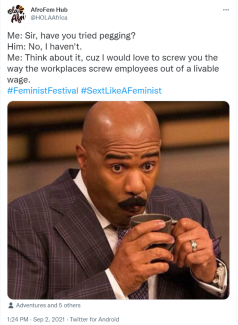
Image of a tweet with the photo of American tv Host Steve Harvey. Text says - Me: Sir, have you tried pegging? Him: No, I haven't. Me: Think about it, cuz I would love to screw you the way the workplaces screw employees out of a livable wage.

2002: comienzan las conversaciones acerca de una agenda de Financiación para el Desarrollo

La Conferencia de Monterrey sobre la Financiación para el Desarrollo marcó el comienzo de las conversaciones acerca de una agenda de Financiación para el Desarrollo.

  • El Consenso de Monterrey fue adoptado durante la primera Conferencia Internacional sobre la Financiación para el Desarrollo. Fue la primera reunión organizada por la ONU con nivel de cumbre para abordar aspectos esenciales del desarrollo global, entre ellos los temas financieros y otros conexos.
  • Durante la Conferencia y sus procesos preparatorios se dio una cooperación sin precedentes entre las Naciones Unidas y el Banco Mundial (BM), el Fondo Monetario Internacional (FMI) y la Organización Mundial del Comercio (OMC) para promover mayor coherencia y cohesión entre los sistemas e instituciones monetarias, comerciales y financieras internacionales.
  • Monterrey también marcó la primera ocasión en que se debatió la financiación para el desarrollo entre gobiernos, representantes de la sociedad civil y el sector empresarial. Estos actores llevaron la discusión más allá de lo ‘técnico’ para abordar cómo movilizar y canalizar recursos financieros a fin de alcanzar las metas internacionalmente convenidas en conferencias y cumbres de la ONU celebradas en la década de 1990, entre ellas los Objetivos de Desarrollo del Milenio (ODM).
  • El WWG [Grupo de Mujeres] señaló el significado histórico de la conferencia, afirmando que tenía el potencial de abordar desafíos estructurales que continúan obstaculizando el desarrollo. Sin embargo, también planteó sus preocupaciones por los efectos del incremento de la militarización y del fundamentalismo sobre las mujeres, pese a que el Consenso de Monterrey dio por sentado que el sistema económico y financiero mundial funcionaba bien para todas las personas.

Para saber más sobre los seis temas centrales de Monterrey los mecanismos de seguimiento a esta conferencia, consulta Género y financiación para el desarrollo, de Maria Floro, Nilufer Çagatay, John Willoughby y Korkut Ertürk (INSTRAW, 2004).

Diana Isabel Hernández Juárez

Diana Isabel Hernández Juárez était une enseignante, défenseure des droits humains et activiste pour l’environnement et les communautés guatémaltèque. Elle coordonnait le programme environnemental de la paroisse de Nuestra Señora de Guadalupe, sur la côte sud du Guatemala. 

Diana a dévoué sa vie à co-créer des actions de sensibilisation à l’environnement, en étroite collaboration avec les communautés locales, dans le but de résoudre les problèmes environnementaux et protéger les ressources naturelles. Elle a été à l’initiative de projets de pépinières forestières, de fermes municipales, de jardins familiaux et de campagnes de nettoyage. Active dans les programmes de reboisement, elle s’est efforçée de récupérer des espèces locales et de remédier aux pénuries d’eau dans plus de 32 communautés rurales.

Le 7 septembre 2019, Diana a été assassinée par balle par deux hommes armés inconnus alors qu’elle participait à une procession dans sa localité. Diana n’avait que 35 ans au moment de son décès.

Snippet - COP30 Join thousands CTAs - EN

Join thousands demanding real climate justice:

Follow the campaign: 

Instagram| BlueSky

Join us!

Join our Membership| Join AWID Community

Stay updated

Subscribe for updates

Questions?
Contact us: communications @ awid.org

Reivindicar los bienes comunes

Definición

La activista y académica Soma Kishore Parthasarathy señala que existen diversas formas de pensar los bienes comunes.

En un sentido más convencional, se los entiende como recursos naturales destinados a ser usados por quienes dependen de su uso. Sin embargo, el concepto de «bienes comunes» se ha expandido para incluir recursos como los conocimientos, la herencia, la cultura, espacios virtuales e incluso el clima. Es un concepto anterior al régimen de propiedad individual y que aportó las bases para la organización social. Las definiciones que aportan las entidades gubernamentales limitan su alcance a los recursos de la tierra y materiales.

El concepto de los bienes comunes se apoya en la práctica cultural de compartir espacios de subsistencia y recursos como dones de la naturaleza, para el bien común, y para la sostenibilidad de lo que es común a todxs.

Contexto

Los bienes comunes de la humanidad están cada vez más amenazados porque las naciones y fuerzas del mercado continúan colonizándolos, explotándolos y ocupándolos.

En algunos contextos favorables, los «bienes comunes» tienen el potencial de habilitar una posición de autonomía sobre todo para las mujeres bajo opresión económica desde la que pueden negociar sus múltiples necesidades y aspiraciones.

Perspectiva feminista

Cuando a las mujeres y a otros géneros oprimidos se les niega el acceso a los bienes comunes y la posibilidad de controlarlos, se refuerza el patriarcado.

Por eso, una economía feminista busca restaurar los derechos legítimos de las comunidades a estos recursos comunes. Esa autonomía les permite mantenerse a sí mismas al mismo tiempo que desarrollan sistemas más igualitarios de gobernabilidad y de uso de esos recursos. Una economía feminista reconoce los roles de las mujeres y les ofrece las mismas oportunidades para tomar decisiones, es decir, las coloca en igualdad de condiciones como demandantes de esos recursos.


Para leer más acerca de esta propuesta:

CFA 2023 - Forum Theme - thai

 ลุกขึ้นพร้อมกัน: เชื่อมต่อ เยียวยา และเติบโต

ประเด็นหลักของเวที – ลุกขึ้นพร้อมกัน (Rising Together) เป็นการเชิญชวนให้ทุกคนกลับมาอยู่กับตัวเองเพื่อเชื่อมต่อซึ่งกันและกันอย่างมีสมาธิ เอาใจใส่ และกล้าหาญ เพื่อให้เราสามารถรู้สึกถึงจังหวะการเต้น ของหัวใจของการเคลื่อนไหวทั่วโลก และลุกขึ้นมารับมือกับความท้าทายในยุคนี้ไปด้วยกัน

นักสตรีนิยม นักปกป้องสิทธิสตรี ความยุติธรรมทางเพศ LBTQI+ และขบวนการพันธมิตรทั่วโลกกำลังอยู่ ในช่วงหัวเลี้ยวหัวต่อที่สำคัญ คือเผชิญกับแรงตอบโต้สิทธิเสรีภาพที่เคยได้รับก่อนหน้านี้ ช่วงไม่กี่ปีที่ผ่านมา ลัทธิอำนาจนิยมเติบโตอย่างรวดเร็ว การปราบปรามภาคประชาสังคมอย่างรุนแรง และการทำให้สตรีและ นักปกป้องสิทธิมนุษยชนที่มีความหลากหลายทางเพศกลายเป็นอาชญากร สงครามและความขัดแย้งที่ ทวีความรุนแรงขึ้นในหลายส่วนของโลก ความอยุติธรรมทางเศรษฐกิจยังคงดำเนินต่อไป รวมทั้งวิกฤตการณ์ ด้านสุขภาพ นิเวศวิทยาและสภาพภูมิอากาศ

การเคลื่อนไหวของเรากำลังสั่นคลอน และในขณะเดียวกันเราก็พยายามสร้างและดำรงความเข้มแข็งและ อดทนเพื่องานข้างหน้า เราไม่สามารถทำงานนี้โดยลำพังในห้องเล็กๆของเราได้ การเชื่อมต่อและ การเยียวยาจึงเป็นสิ่งสำคัญในการปรับเปลี่ยนความไม่สมดุลของพลังงานและข้อบกพร่องภายในการเคลื่อน ไหวของเราเอง เราต้องทำงานและวางยุทธศาสตร์ในลักษณะที่เชื่อมโยงกัน เพื่อที่เราจะสามารถเติบโต ไปด้วยกันได้ เวที AWID จะส่งเสริมองค์ประกอบสำคัญของการเชื่อมโยงถึงกันกับพลังความสามารถ การเติบโต และการสร้างความเปลี่ยนแปลงของนักสตรีนิยมทั่วโลก

La comunicación del deseo y otras praxis políticas del cuerpo | Title Snippet ES

La comunicación del deseo y otras praxis políticas del cuerpo

con Manal Tamimi, Lindiwe Rasekoala y Louise Malherbe
Crédito del podcast: Zuhour Mahmoud