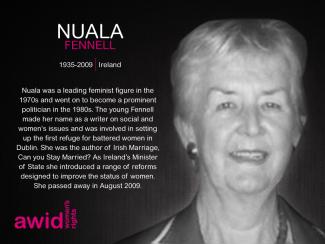
Nuala Fennell
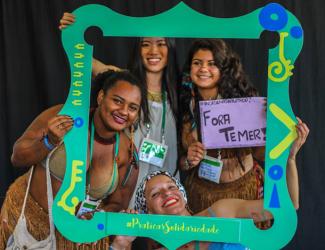
Young feminist activists play a critical role in women’s rights organizations and movements worldwide by bringing up new issues that feminists face today. Their strength, creativity and adaptability are vital to the sustainability of feminist organizing.
At the same time, they face specific impediments to their activism such as limited access to funding and support, lack of capacity-building opportunities, and a significant increase of attacks on young women human rights defenders. This creates a lack of visibility that makes more difficult their inclusion and effective participation within women’s rights movements.
AWID’s young feminist activism program was created to make sure the voices of young women are heard and reflected in feminist discourse. We want to ensure that young feminists have better access to funding, capacity-building opportunities and international processes. In addition to supporting young feminists directly, we are also working with women’s rights activists of all ages on practical models and strategies for effective multigenerational organizing.
We want young feminist activists to play a role in decision-making affecting their rights by:
Fostering community and sharing information through the Young Feminist Wire. Recognizing the importance of online media for the work of young feminists, our team launched the Young Feminist Wire in May 2010 to share information, build capacity through online webinars and e-discussions, and encourage community building.
Researching and building knowledge on young feminist activism, to increase the visibility and impact of young feminist activism within and across women’s rights movements and other key actors such as donors.
Promoting more effective multigenerational organizing, exploring better ways to work together.
Supporting young feminists to engage in global development processes such as those within the United Nations
Collaboration across all of AWID’s priority areas, including the Forum, to ensure young feminists’ key contributions, perspectives, needs and activism are reflected in debates, policies and programs affecting them.
Absolutely, we want to hear about your experience with resourcing.
Dre. Margo Okazawa-Rey est titulaire de la Chaire Barbara Lee pour le leadership des femmes et professeure invitée en études sur les femmes, le genre et la sexualité et en politique publique au Mills College à Oakland, en Californie. Elle est également professeure émérite à la San Francisco State University.
Ses principaux domaines de recherche et d’activisme au cours des 25 dernières années sont le militarisme, les conflits armés et la violence à l’égard des femmes, analysés de manière intersectionelle. Professeure Okazawa-Rey siège au conseil consultatif international de Du Re Bang à Uijongbu en Corée du Sud, au Conseil international de PeaceWomen Across the Globe à Berne, en Suisse, et est co-présidente du conseil du Highlander Research and Education Centre à New Market, Tennessee aux États-Unis.
Ses publications récentes incluent « Nation-izing » Coalition and Solidarity Politics for US Anti-militarist Feminists (en presse) ; « No Freedom without Connections: Envisioning Sustainable Feminist Solidarities » (2018) dans Feminist Freedom Warriors : Genealogies, Justice, Politics, and Hope, Chandra Talpade Mohanty et Linda Carty (ed.) ; Between a Rock and Hard Place: Southeast Asian Women Confront Extractivism, Militarism, and Religious Fundamentalisms (2018) ; à « Liberal Arts Colleges Partnering with Highlander Research and Education Center : Intergenerational Learning for Student Campus Activism and Personal Transformation, » numéro spéciale de Feminist Formations (Feminist Social Justice Pedagogy, (2018).

El financiamiento externo incluye donaciones y otras formas de financiamiento provenientes de fundaciones filantrópicas, gobiernos, donantes bilaterales, multilaterales y corporativos y de donantes individuales, ya sea que estos se encuentren radicados en tu país o en el exterior. Excluye aquellos recursos que las agrupaciones, organizaciones o movimientos generan de manera autónoma como, por ejemplo, cuotas de membresía, contribuciones voluntarias del personal, afiliadxs o adherentes, colectas comunitarias, alquiler de espacios propios o venta de servicios. Para consultar más referencias, en la propia encuesta se encuentran incluidas las definiciones de los distintos tipos de financiamiento y descripciones breves de distintos tipos de donantes.

Salome is a feminist activist from Tbilisi, Georgia, devoted to social and gender justice. She holds a Master's degree in gender studies, and has been engaged in feminist, queer and green movements for over twelve years, working amongst others on issues of gender based violence, domestic violence, sexual and reproductive health and rights, LGBTIQ rights, [women’s] Labor Rights, Healing Justice and holistic and digital security and rights.
Since 2014 she has been actively working on safety and security issues of activists and Women Human Rights Defenders, providing integrated security and digital security workshops specifically for activists from under-privileged groups (queer persons, ethnic and religious minorities, rural women and girls, etc) as well as bigger feminist organisations. Salome is a member of the Independent Group of Feminists - a non-formal, non-hierarchical and non-registered initiative that unites feminists with diverse backgrounds in Georgia. Currently, she is the Executive Director of the Women's Fund in Georgia, fully engaged in women's/feminist movement building, providing feminist funding, and encouraging local feminist philanthropy.
L’AWID est engagée en faveur de la justice linguistique, et nous regrettons que l’enquête WITM ne puisse, à l’heure actuelle, être accessible dans d’autres langues. Cependant, si vous avez besoin d’une aide à la traduction ou que vous souhaitez participer à l’enquête dans une autre langue, n’hésitez pas à nous contacter à l’adresse witm@awid.org.
Michelle es una feminista de Sudeste Asiático que disfruta de conspirar para congregar a las personas y suscitar conversaciones para el cambio social y el intercambio de conocimientos feministas, a través del arte, la poesía, la música y el juego. Con experiencia en promoción digital y desarrollo de estrategias de comunicación, ha contribuido a iniciativas de derechos digitales, investigaciones en derechos humanos y a la construcción de coaliciones de la sociedad civil a lo largo y ancho del Sudeste Asiático. Posee una licenciatura en Derecho de la Universidad Nacional de Singapur, disfruta de pasear al azar por las calles de la ciudad y le gusta un poquito demasiado el café.

Escucha esta historia aquí:
The estimated time to complete the survey is 30 minutes.
Contenu lié
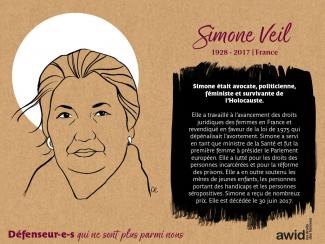
Huffington Post: Mort de Simone Veil: l'ancienne ministre de la Santé est décédée ce vendredi
Le Monde: Mort de Simone Veil, icône de la lutte pour les droits des femmes
Eni Lestari est travailleuse domestique indonésienne à Hong Kong et militante des droits des migrant·e·s. Après avoir échappé à son employeur abusif, elle est passée de victime à mobilisatrice de travailleurs·ses domestiques en particulier, et de travailleurs·ses migrant·e·s plus globalement. En 2000, elle a fondé l'Association of Indonesian Migrant Workers (Association des travailleurs·ses migrant·e·s indonésien·ne·s, ATKI-Hong Kong) qui s'est ensuite étendue à Macao, à Taïwan et en Indonésie. Elle a été coordonnatrice et porte-parole de l'Asia Migrants Coordinating Body (Instance de coordination des migrant·e·s en Asie, AMCB) - une alliance d'organisations de terrain de migrant·e·s à Hong Kong venant d'Indonésie, des Philippines, de Thaïlande, du Népal et du Sri Lanka. Elle est également l'actuelle présidente de l’International Migrants Alliance (Alliance internationale des migrant·e·s), la toute première alliance mondiale de migrant·e·s, d'immigré·e·s, de réfugié·e·s et d'autres personnes déplacées.
Elle a occupé des postes importants dans diverses organisations, en tant que membre actuelle du conseil régional de l’Asia Pacific Forum on Women, Law and Development (Forum Asie-Pacifique sur les femmes, le droit et le développement, APWLD), ancienne membre du conseil d'administration de Global Alliance Against Traffic in Women (Alliance mondiale contre la traite des femmes, GAATW), porte-parole du Network of Indonesian Migrant Workers (Réseau des travailleurs·ses migrant·e·s indonésien·ne·s, JBMI), conseillère d’ATKI-Hong Kong et Macao ainsi que de l’Association of Returned Migrants and Families in Indonesia (Association des migrant·e·s et des familles retourné·e·s en Indonésie, KABAR BUMI). Elle a été une personne-ressource impliquée dans des forums organisés par des universitaires, des groupes interreligieux, des sociétés civiles, des syndicats et bien d'autres, à l’échelle nationale, régionale et internationale.
Elle a aussi participé activement aux assemblées/conférences des Nations Unies sur le développement et les droits des migrant·e·s et été choisie comme intervenante pour l'ouverture de l'Assemblée générale des Nations Unies sur les mouvements massifs de migrant·e·s et de réfugié·e·s en 2016 à New York, aux États-Unis. Des nominations et des prix lui ont par ailleurs été décernés, dont celui d’Inspirational Women de BBC 100 Women, ainsi que le prix Public Hero de RCTI, l’Indonesian Club Award et le Non-Profit Leader of Women of Influence de la Chambre américaine de Hong Kong, et celui de Changemaker de Cathay Pacific.