Flickr/Leonardo Veras (CC BY 2.0)

Special Focus

AWID is an international, feminist, membership organisation committed to achieving gender equality, sustainable development and women’s human rights

Protection of the Family

The Issue

Over the past few years, a troubling new trend at the international human rights level is being observed, where discourses on ‘protecting the family’ are being employed to defend violations committed against family members, to bolster and justify impunity, and to restrict equal rights within and to family life.

The campaign to "Protect the Family" is driven by ultra-conservative efforts to impose "traditional" and patriarchal interpretations of the family, and to move rights out of the hands of family members and into the institution of ‘the family’.

“Protection of the Family” efforts stem from:

  • rising traditionalism,
  • rising cultural, social and religious conservatism and
  • sentiment hostile to women’s human rights, sexual rights, child rights and the rights of persons with non-normative gender identities and sexual orientations.

Since 2014, a group of states have been operating as a bloc in human rights spaces under the name “Group of Friends of the Family”, and resolutions on “Protection of the Family” have been successfully passed every year since 2014.

This agenda has spread beyond the Human Rights Council. We have seen regressive language on “the family” being introduced at the Commission on the Status of Women, and attempts made to introduce it in negotiations on the Sustainable Development Goals.


Our Approach

AWID works with partners and allies to jointly resist “Protection of the Family” and other regressive agendas, and to uphold the universality of human rights.

In response to the increased influence of regressive actors in human rights spaces, AWID joined allies to form the Observatory on the Universality of Rights (OURs).  OURs is a collaborative project that monitors, analyzes, and shares information on anti-rights initiatives like  “Protection of the Family”.

Rights at Risk, the first OURs report, charts a map of the actors making up the global anti-rights lobby, identifies their key discourses and strategies, and the effect they are having on our human rights.   

The report outlines “Protection of the Family” as an agenda that has fostered collaboration across a broad range of regressive actors at the UN.  It describes it as: “a strategic framework that houses “multiple patriarchal and anti-rights positions, where the framework, in turn, aims to justify and institutionalize these positions.”
 

Related Content

2007: CSO engagement rises with the creation of the WWG on FfD

The Women’s Working Group on Financing for Development (WWG on FfD), an alliance of women’s rights organizations and networks, was launched in October 2007 to advocate for the advancement of gender equality, women’s empowerment and human rights in the FfD related UN processes.  

  • The Third High-level Dialogue on Financing for Development, 23-25 October 2007 saw an upsurge in civil society participation. Aside from the six round table sessions, there were hearings for civil society and the business sector.
  • AWID delivered a statement at the plenary on behalf of Civil Society calling for governments to give greater attention to the importance of women’s rights organizations as agents of development, and the need to promote new mechanisms for financing for women in developing and least developed countries. The statement urged governments to give greater support to gender architecture in the United Nations so that the system as a whole could make progress in terms of its commitment to gender equality, women’s empowerment and human rights, including the economic, social, cultural and environmental rights of all persons. 

Snippet - CSW68 - Follow the Money - FR

Suivre la piste de l'argent :

Flux financiers illicites et acteurs antidroits

📅Lundi 11 mars
🕒16 h 30 - 18 h HNE

Organisateurs : AWID, IJSC et NAWI
🏢 Church Center des Nations Unies, 777 United Nations Plaza, New York, 11e étage
(Interprétation en français et en espagnol disponible)

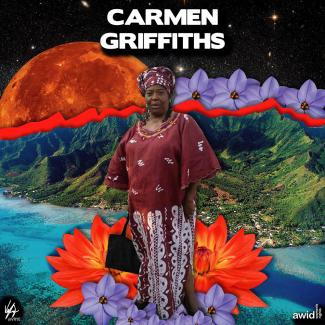
Carmen Griffiths

Carmen was the Head of the Construction Resource and Development Collective (CRDC) and was instrumental in supporting women’s involvement in the construction industry in Jamaica.

She also worked on issues of disaster preparedness for rural and urban women. She worked closely with women (especially single mothers) teaching them how to use hurricane straps and other technology to secure their homes. She worked in the area of water and sanitation and was a strong advocate for sustainable environmental management and development.

She was a part of the Huairou Commission and advocated for grassroots women on such issues as shelter, energy, and sustainable livelihoods.


Carmen Griffiths, Jamaica

Snippet FEA Ocupação 9 de Julho is more than just a building (EN)

But Ocupação 9 de Julho is more than just a building.

It is a community hub, where one can take courses and train in creative income-generation activities like local hairdressing, cooking and artmaking. Children can also enjoy cultural and educational activities. The MSTC doesn't work alone. It collaborates with institutions and art collectives to produce cultural, athletic and educational experiences, alongside critical access to health care. Since its inception, this participatory project has been led and carried out by mostly women, under the leadership of Afro-Brazilian activist Carmen Silva, who was once a homeless person herself.

2013: el sexto Diálogo de Alto Nivel revisa el progreso de los ODM

  • El Sexto Diálogo de Alto Nivel sobre la Financiación para el Desarrollo, que tuvo lugar el 7 y 8 de octubre de 2013, se centró en analizar los progresos hacia los ODM e identificar las brechas a ser abordadas en las conversaciones acerca del nuevo marco para el desarrollo.
  • Durante la sesión, el Grupo de Trabajo sobre el desfase en el logro de los ODM presentó un informe en el que hizo referencia al fracaso en alcanzar el ODM 8 (Alianza mundial para el desarrollo) como un factor decisivo que explicaba los obstáculos para el logro de los demás ODM. Ese informe demostró que en el nuevo marco para el desarrollo post-2015 se debía prestar más atención a crear alianzas globales fuertes que garantizaran compromisos vinculantes.

Snippet - CSW68 - March 13 - FR

Jour 3

13 Mars

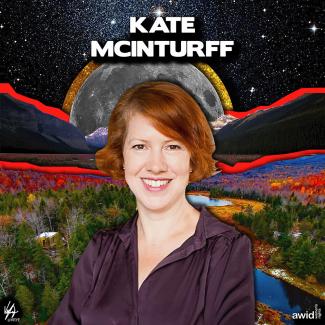
Kate McInturff

Desde su paso por Peacebuild hasta la Canadian Feminist Alliance for International Action [alianza feminista canadiense para la acción internacional], Amnistía Internacional y el Canadian Centre for Policy Alternatives (CCPA, centro canadiense para las alternativas políticas), Kate tuvo durante toda su vida una pasión por los derechos de las mujeres y la igualdad de género y dedicó su carrera a luchar contra la desigualdad y a hacer del mundo un lugar más compasivo.

Fue integrante del Comité Coordinador de Social Watch [observatorio social] y colaboró con los informes del Observatorio Social Nacional canadiense. Como investigadora senior en el CCPA, Kate fue aclamada a nivel nacional por hacer la investigación, escribir y producir el informe anual «Los mejores y los peores lugares para ser mujer en Canadá».

Murió tranquilamente, rodeada de su familia, luego de una batalla de tres años con el cáncer de colon. Sus seres queridos la describen como «una feminista divertida, valiente y sin remordimientos».


Kate McInturff, Canada

Snippet FEA NORTH CAUCA Left (ES)

NORTE DEL CAUCA, COLOMBIA

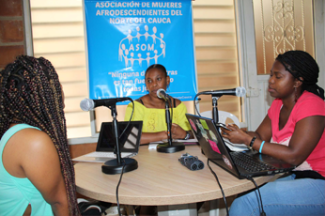
Asociación de Mujeres Afrodescendientes del Norte del Cauca (ASOM)


¡MERECEMOS

MAS!

Avril 2015: des audiences interactives avec le secteur privé et la société civile ont lieu

  • Des audiences interactives informelles avec le secteur privé et avec la société civile se sont respectivement tenues les 8 et 9 avril 2015, au siège  de l’ONU à New York.
  • Les organisations de défense des droits des femmes et d’autres OSC ont souligné la faiblesse de la participation des États membres aux audiences des OSC. Le Groupe de coordination des OSC d’Addis Abeba a donc adressé à ce sujet une lettre aux co-facilitateurs (en anglais).
  • La seconde session de rédaction du document final d’Addis Abeba s’est tenue du 13 au 17 avril 2015, au siège de l’ONU. Les discussions se sont appuyées sur la version zéro (en anglais).
  • Le WWG sur le FdD a présenté aux États membres ses recommandations sur les différents thèmes du FdD (document en anglais) lors de différentes sessions officielles et manifestations parallèles. Les femmes ont exprimé leurs inquiétudes dans différents domaines clés. Elles ont notamment déploré le fait que la version zéro ne souligne qu’insuffisamment les conséquences négatives graves des crises financières, provoquées par l’instabilité des systèmes financiers internationaux, sur le développement, l’égalité et les droits humains, et en particulier sur les droits humains des femmes.

Snippet - WITM survey is focused on - EN

The WITM survey is focused on the feminist resourcing realities of the last 3 years (2021 to 2023), and has five key sections:

  1. Group information
  2. Financial status
  3. Shifting power
  4. Sustainability
  5. Key aspirations

It consists of mandatory* and optional questions, most of which are multiple-choice. You will have a chance to share more on issues that are important to you by responding to the open question(s) at the end of the survey.

Hand holding magnifying glass

To respond to the questions quickly and easily, we advise that you have your key financial information at hand (e.g., your annual budgets from 2021 to 2023). However, if you wish to save your responses and come back to the survey later, you are able to do this whenever needed.

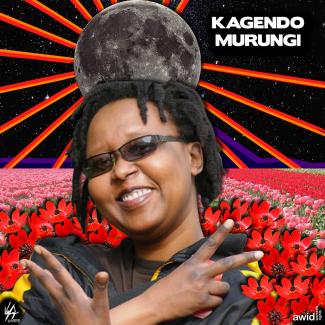
Kagendo Murungi

Sa famille et ses ami-e-s se souviennent de Kagendo comme d'une activiste, féministe, artiste et cinéaste africaine acharnée

Elle a consacré plus de 20 ans à défendre les droits et la dignité des personnes LGBTIQ d'Afrique et des personnes non conformes du genre. Les collègues de Kagendo se souviennent d'elle comme une personne à la personnalité joviale, à la conviction sans faille et qui aimait la vie. Kagendo est décédée de cause naturelle chez elle à Harlem le 27 décembre 2017.

L'écrivaine et activiste kényane, Shailja Patel, a commenté son décès en ces termes « Tout au long de sa vie, l'engagement de Kagendo à établir des liens entre toutes les formes d’oppressions et à montrer comment le colonialisme a favorisé l'homophobie sur le continent africain, a contribué à rapprocher le Kenya d’un pays où les personnes queer et les femmes indépendantes pourraient vivre et prospérer. »


Kagendo Murungi, Kenya

Snippet FEA ASOM’s activists in encounters (FR)

 
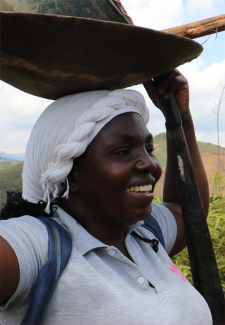
Black woman in a white headscarf and gray t-shirt, she is smiling and is holding a vessel above her head
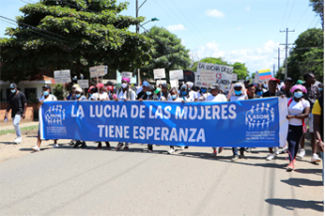
People demonstrating and holding a long blue poster
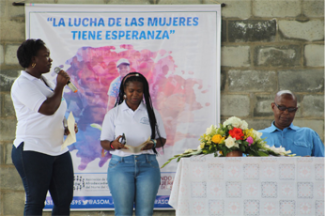
Black woman speaking in a mic, there is a black girl standing next to her and a man sitting at the table
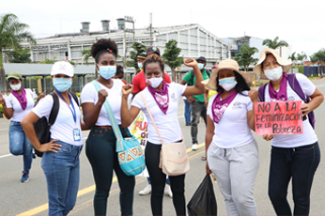
Photo of five black women in the front on a demonstration, wearing facemasks and holding posters
Photo of three women sitting around the table and talking in mics.

Les militants de l'ASOM dans les rencontres, les défilés et les événements

Snippet - WITM To make - EN

To make the complexity of resourcing diverse forms of feminist organizing visible

Teresia Teaiwa

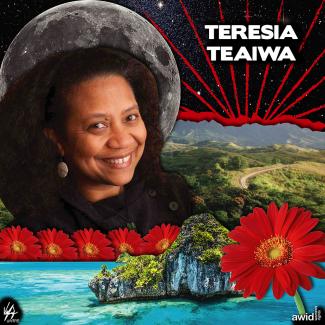
Described by the Guardian as one of Kiribati’s national icons, Teresia was a fearless advocate who worked closely with feminist groups in Fiji.

She used her research to address the issues of feminism and gender in the Pacific, as well as being co-editor of the International feminist Journal of Politics. Her influence spanned the academic frontier as well as social justice movements in the Oceania region.


Teresia Teaiwa, Fiji

Snippet FEA Environments Of Shelter (EN)

Metzineres provides the following kinds of support, known as

Environments of Shelter: