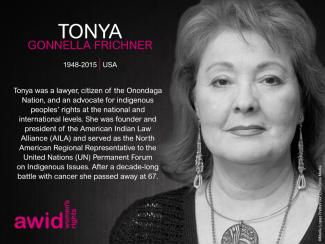
Tonya Gonella Frichner
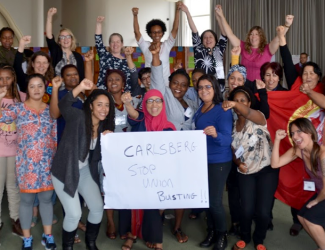
Women human rights defenders (WHRDs) worldwide defend their lands, livelihoods and communities from extractive industries and corporate power. They stand against powerful economic and political interests driving land theft, displacement of communities, loss of livelihoods, and environmental degradation.
Extractivism is an economic and political model of development that commodifies nature and prioritizes profit over human rights and the environment. Rooted in colonial history, it reinforces social and economic inequalities locally and globally. Often, Black, rural and Indigenous women are the most affected by extractivism, and are largely excluded from decision-making. Defying these patriarchal and neo-colonial forces, women rise in defense of rights, lands, people and nature.
WHRDs confronting extractive industries experience a range of risks, threats and violations, including criminalization, stigmatization, violence and intimidation. Their stories reveal a strong aspect of gendered and sexualized violence. Perpetrators include state and local authorities, corporations, police, military, paramilitary and private security forces, and at times their own communities.
AWID and the Women Human Rights Defenders International Coalition (WHRD-IC) are pleased to announce “Women Human Rights Defenders Confronting Extractivism and Corporate Power”; a cross-regional research project documenting the lived experiences of WHRDs from Asia, Africa and Latin America.
"Women Human Rights Defenders confronting extractive industries: an overview of critical risks and Human Rights obligations" is a policy report with a gender perspective. It analyses forms of violations and types of perpetrators, quotes relevant human rights obligations and includes policy recommendations to states, corporations, civil society and donors.
"Weaving resistance through action: Strategies of Women Human Rights Defenders confronting extractive industries" is a practical guide outlining creative and deliberate forms of action, successful tactics and inspiring stories of resistance.
The video “Defending people and planet: Women confronting extractive industries” puts courageous WHRDs from Africa, Asia, and Latin America in the spotlight. They share their struggles for land and life, and speak to the risks and challenges they face in their activism.
Challenging corporate power: Struggles for women’s rights, economic and gender justice is a research paper outlining the impacts of corporate power and offering insights into strategies of resistance.
AWID acknowledges with gratitude the invaluable input of every Woman Human Rights Defender who participated in this project. This project was made possible thanks to your willingness to generously and openly share your experiences and learnings. Your courage, creativity and resilience is an inspiration for us all. Thank you!
Опрос будет доступен до конца августа 2024 года. Пожалуйста, заполните его в течение этого срока, чтобы ваши ответы были включены в анализ.
Magaly Quintana était connue de nombreuses personnes au Nicaragua comme « La Maga » (la magicienne). Historienne et activiste féministe, elle était une indéfectible défenseure des droits des femmes, réclamant justice pour les victimes de féminicides.
Magaly était fortement engagée dans la documentation et la collecte de statistiques sur les femmes et les filles tuées dans le cadre de la violence sexuelle dans le pays.
« Elle s’employait à reconstituer la vie de chacune d’entre elles, de leur famille, pour montrer ces vies qui avaient été détruites », Dora María Téllez.
Magaly avait également critiqué le gouvernement pour sa réforme de la loi 779 sur la violence à l’égard des femmes. Résultat du travail acharné des mouvements de femmes nicaraguayens, cette loi incluait – avant sa réforme – d’importantes dispositions criminalisant le féminicide. Elle avançait que les réformes législatives avaient affaibli la loi et restreint la définition des féminicides à des homicides, rendant ainsi « invisibles » les crimes violents perpétrés contre les femmes.
Magaly a commencé à mener des actions féministes au début des années 1980. Directrice du Catholic Women for the Right to Choose, elle a défendu le droit à l’avortement thérapeutique après son interdiction en 2006, de même que soutenu les manifestations contre le gouvernement de Daniel Ortega en 2018.
Née en mai 1952, Magaly est décédée en mai 2019.
« Nous nous reverrons plus tard, ma très chère Magaly Quintana. Merci beaucoup, merci pour l’héritage que tu nous laisses. Nous te reverrons, aussi forte et puissante que toujours. », Erika Guevara Rosas (Directrice américaine d’Amnesty International)
Ritu es una tecnóloga feminista que aporta su experiencia en el sector sin fines de lucro, movida por la pasión de utilizar enfoques innovadores para encontrar soluciones tecnológicas en clave feminista. Con una maestría en Tecnología de las Aplicaciones Informáticas del Instituto de Tecnología de la India, su función en AWID abarca una diversidad de responsabilidades. Desde la supervisión de la seguridad digital y la gestión de servidores, hasta la administración de las bases de datos, pasando por el desarrollo de capacidades, la evaluación de tecnologías, la implementación de software y soluciones en la nube, Ritu vela por la resiliencia y la efectividad de la infraestructura de las tecnologías de la información de AWID. Antes de incorporarse a AWID, desempeñó un papel fundamental en la promoción de iniciativas tecnológicas en los sectores del medio ambiente y de la promoción de la salud, impulsada por su afán de aprovechar la tecnología en aras del bien social.
Manal Tamimi es una activista y defensora de los derechos humanos palestina. Tiene cuatro hijxs y posee una maestría en derecho humanitario internacional. Debido a su activismo, fue arrestada en tres ocasiones y sufrió más de una herida, incluso balas explosivas reales, algo prohibido en el plano internacional. Su familia también es blanco de agresiones: sus hijxs han sido arrestados y sufrido heridas con munición activa más de una vez. El último hecho fue un intento de asesinato contra su hijo Muhammad, quien recibió un disparo en el pecho cerca del corazón, unas semanas después de ser liberado de las prisiones de la ocupación en las que había estado dos años. Su filosofía de vida: si tengo que pagar un precio por ser palestina y no por un delito que haya cometido, me niego a morir callada.
Building on our 20-year history of mobilizing more and better funding for feminist-led social change, AWID invites you to complete the new iteration of our flagship survey, WITM.
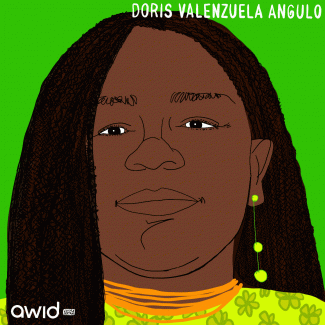
Doris Valenzuela Angulo was an Afro-descendant social activist, leader and human rights defender from Buenaventura, Colombia. She was part of Communities Building Peace in the Territories (CONPAZ), a national network of organizations in communities affected by armed conflict that advocate for non-violence and socio-environmental justice.
Doris defied constant paramilitary violence and pressures from mega projects to displace her community and state collusion. Faced with one of the most difficult contexts in her country, she played a leadership role in an unprecedented initiative of non-violent resistance called Puente Nayero Humanitarian Space, an urban place for community cohesion, safety, creativity and collective action.
This unique non-violent struggle of the families that belonged to Puente Nayero Humanitarian Space, attracted attention and support from both local and international agencies. By September 2014, the Inter-American Commission on Human Rights had granted precautionary protection measures to the community ordering the Colombian State to adopt necessary measures to preserve their lives and personal integrity. However, the threats and violence from the paramilitaries continued. Doris focused her energies on preventing forced recruitment of children and young people by the neo-paramilitaires, continuing on despite the murder of her son Cristian Dainer Aragón Valenzuela in July 2015. Doris also became a target, continuously receiving threats for her activism and the work she did.
The continued aggression and threats against her life forced Doris to leave Colombia. She was residing in Spain from February 2017 to February 2018, as part of the Amnesty International temporary protection program for human rights defenders at risk. In April 2018, Doris was murdered in Murcia, Spain by her ex-partner. She was only 39 years old.
"Doris, spending a whole year with you has taught us how a person can have the ability to transform and generate hope in the face of deeply negative and devastating events during your life...We continue with our commitment in the defense of all human rights. Your courage and your light will always guide us.” - Montserrat Román, Amnesty International Grupo La Palma
"..You knew it. You always knew. And in spite of everything you stood firm against so many injustices, so many miseries, so much persecution. You stood up, haughty and fierce, against those who wanted to make you again abandon your hopes, humble yourself and surrender. Standing up you cried out for your freedom and ours that was yours. Nothing and no one paralyzed your efforts to change the world and make it more generous and livable. You, live among us, more alive today than ever among us despite death. Always live by your gestures, your courage, your greatness when crying for a promised land that you came to invoke with each of your cries for all the deserts you inhabited. You. Always alive. Doris Valenzuela Angulo.
They are only words. I know. I know it too. But the words unite us, protect us, give us strength and encouragement to continue walking towards the light that you defended so much…”
Priscilla a près de deux décennies d'expérience de travail dans le secteur non lucratif et des organisations de justice sociale qui travaillent sur les droits des femmes et des jeunes, la conservation, la consolidation de la paix et le développement. Elle s’intéresse à la mise en place de processus et de systèmes progressifs qui aident les organisations à respecter leurs valeurs et principes pour s’épanouir, et à l’obtention de moyens permettant aux organisations et aux personnes qui collectent des fonds d’allouer et de sécuriser les ressources nécessaires à la réalisation d’un travail de qualité. Priscilla a rejoint l'AWID en 2018 en tant que responsable de la mobilisation des ressources, pour ensuite assumer le rôle de directrice des opérations et des partenariats financiers à partir de juillet 2023.
Priscilla est titulaire d'un master en politique internationale de l’École des Études Orientales et Africaines (SOAS). Elle tient une pile, de plus en plus grande, de livres pour lesquels elle essaie toujours de trouver du temps pour les lire. Elle siège au sein du conseil d'administration de la Hodan Somali Community, une organisation caritative basée à Londres.
This journal edition in partnership with Kohl: a Journal for Body and Gender Research, will explore feminist solutions, proposals and realities for transforming our current world, our bodies and our sexualities.
Ces informations sont disponibles dans notre Appel à activités, et notamment sa section intitulée « Ce qu’il faut savoir ».
Mena Mangal fue una destacada periodista de televisión, defensora de los derechos de las mujeres y asesora cultural de la Wolesi Jirga, la cámara baja del parlamento nacional de Afganistán.
Durante más de una década, trabajó para Ariana TV, el canal Lamar de lengua Pashto de Tolo TV, y para la emisora privada de televisión nacional afgana Shamshad TV. Como presentadora, Mena se enfocó en los derechos de las mujeres y en los programas de entrevistas culturales.
"La defensora de los derechos de la mujeres Wazhma Frogh dijo que Mangal "tenía una voz fuerte" y se pronunció activamente como defensora de su pueblo".
Fuera de la pantalla, también dirigió páginas populares de redes sociales que defendían los derechos de las niñas y mujeres afganas a la educación y el trabajo. En lo que concierne a su vida privada, Mena escribió extensamente acerca de cómo había sido forzada a contraer un matrimonio arreglado en 2017, y sobre el proceso que tuvo que atravesar para poder obtener finalmente el divorcio.
En un post de Facebook, Mena escribió que estaba recibiendo amenazas de muerte de fuentes desconocidas, pero que aun así continuaría llevando a cabo su trabajo.
El 11 de mayo de 2019, Mena fue atacada por hombres armados desconocidos y asesinada a tiros a plena luz del día en un espacio público del sudeste de Kabul.
"Estamos preocupadxs por la situación actual ya que está teniendo un impacto directo en las mujeres que trabajan fuera de sus casas... Las mujeres periodistas están cambiando de profesión debido a los crecientes riesgos que enfrentan". - Robina Hamdard, defensora de los derechos de las mujeres en Kabul.
Umyra Ahmad is a Malaysian feminist with a background in international and regional advocacy, and human rights education. In AWID, she works on advancing rights related to gender and sexuality at the UN. Prior to joining, she was a programme officer at IWRAW Asia Pacific, where she supported regional, national and grassroots organizations in using UN treaty body mechanisms as a tool for state accountability and access to justice. In Malaysia, she works with queer and refugee collectives and supports coordination of various mutual aid initiatives.

مريم مكيوي مخرجة أفلام ومصورة من الإسكندرية تعيش وتعمل في برلين.