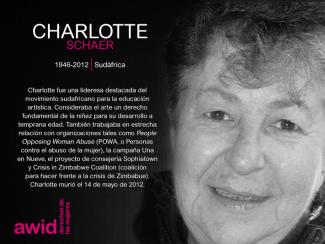
Charlotte Schaer
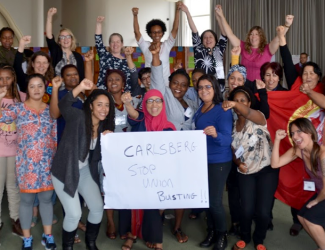
Women human rights defenders (WHRDs) worldwide defend their lands, livelihoods and communities from extractive industries and corporate power. They stand against powerful economic and political interests driving land theft, displacement of communities, loss of livelihoods, and environmental degradation.
Extractivism is an economic and political model of development that commodifies nature and prioritizes profit over human rights and the environment. Rooted in colonial history, it reinforces social and economic inequalities locally and globally. Often, Black, rural and Indigenous women are the most affected by extractivism, and are largely excluded from decision-making. Defying these patriarchal and neo-colonial forces, women rise in defense of rights, lands, people and nature.
WHRDs confronting extractive industries experience a range of risks, threats and violations, including criminalization, stigmatization, violence and intimidation. Their stories reveal a strong aspect of gendered and sexualized violence. Perpetrators include state and local authorities, corporations, police, military, paramilitary and private security forces, and at times their own communities.
AWID and the Women Human Rights Defenders International Coalition (WHRD-IC) are pleased to announce “Women Human Rights Defenders Confronting Extractivism and Corporate Power”; a cross-regional research project documenting the lived experiences of WHRDs from Asia, Africa and Latin America.
"Women Human Rights Defenders confronting extractive industries: an overview of critical risks and Human Rights obligations" is a policy report with a gender perspective. It analyses forms of violations and types of perpetrators, quotes relevant human rights obligations and includes policy recommendations to states, corporations, civil society and donors.
"Weaving resistance through action: Strategies of Women Human Rights Defenders confronting extractive industries" is a practical guide outlining creative and deliberate forms of action, successful tactics and inspiring stories of resistance.
The video “Defending people and planet: Women confronting extractive industries” puts courageous WHRDs from Africa, Asia, and Latin America in the spotlight. They share their struggles for land and life, and speak to the risks and challenges they face in their activism.
Challenging corporate power: Struggles for women’s rights, economic and gender justice is a research paper outlining the impacts of corporate power and offering insights into strategies of resistance.
AWID acknowledges with gratitude the invaluable input of every Woman Human Rights Defender who participated in this project. This project was made possible thanks to your willingness to generously and openly share your experiences and learnings. Your courage, creativity and resilience is an inspiration for us all. Thank you!
2-5 ธันวาคม 2567 กรุงเทพ ประเทศไทย! เราจะรวมตัวกันที่ศูนย์การประชุมแห่งชาติสิริกิติ์และจัดให้มีการประชุมแบบเสมือนจริงออนไลน์ไปพร้อมกันด้วย
Primer Diálogo de Alto Nivel sobre la Financiación para el Desarrollo, 29 y 30 de octubre de 2003
Uno de los mecanismos de seguimiento de la Conferencia de Monterrey fueron los Diálogos de Alto Nivel sobre la Financiación para el Desarrollo organizados cada dos años por la Asamblea General de la ONU. En total, ya se realizaron ocho mesas redondas en las que se ha continuado el Diálogo acerca de distintos temas como los subsidios a la agricultura, el comercio, el alivio de la deuda y la financiación para los ODM. En todas ellas se prestó especial atención a los obstáculos estructurales que colocan en desventaja a las naciones ‘en desarrollo’.
Otros mecanismos de seguimiento a Monterrey son los siguientes:

نرحب بالطلبات عبر مجموعة كاملة من المواضيع والتقاطعات المهمة للحركات النسوية وحركات العدالة الجندرية. في نموذج الطلب، ستتمكن/ين من تحديد أكثر من موضوع يناسب نشاطك.

Louise Malherbe est une programmatrice/commissaire de films et une critique de cinéma basée à Berlin. Elle a travaillé comme programmatrice de films pour l’association Metropolis Cinema à Beyrouth et coordonne aujourd’hui le projet Reel Streams qui vise à soutenir la diffusion du cinéma indépendant dans la région arabe. Elle est responsable de la programmation du Soura Film Festival, un festival de films queer centré sur la région S.W.A.N.A., écrit des critiques de films pour Manifesto XXI et est depuis peu commissaire de films et de festivals pour Cinema Akil.
AWID ไม่มีส่วนลดสำหรับการลงทะเบียนแบบกลุ่ม แต่เรามีส่วนลดสำหรับสมาชิก (คลิกที่นี่เพื่อดูวิธีการเข้าเป็นสมาชิก)

สำหรับข้อมูลด้านนี้สามารถอ่านรายละเอียดได้ที่ เปิดรับสมัครกิจกรรม รวมถึงข้อมูลในหัวข้อ “สิ่งที่คุณต้องรู้”
Informal interactive hearings with the business sector and civil society took place on 8 and 9 April 2015 respectively at UN headquarters in New York.

Ester Lopes est une danseuse et une écrivaine dont les recherches portent sur le corps, le genre, la race et les rapports de classe. Elle est professeure de Pilates et enseigne l’art. Ester est diplômée en théâtre contemporain – processus créatifs (à la FAINC) et en danse et conscience du corps (à l’USCS). Parmi ses spécialisations musicales figurent le chant populaire et les percussions. Elle a suivi une formation à Novos Brincantes avec Flaira Ferro, Mateus Prado et Antonio Meira à l’Institut Brincante en 2015 et 2016.

La financiación para el desarrollo encierra amenazas y oportunidades concretas para los derechos de las mujeres y los derechos humanos de todas las personas. Una financiación y políticas para el desarrollo que sean transformadoras pueden constituir un aporte importante para los cambios sistémicos que se necesitan a fin de garantizar el respeto, la protección y la realización de los derechos humanos de las mujeres.
El año 2015 es importante en el proceso de la FpD. La tercera Conferencia Internacional sobre la FpD tuvo lugar del 13 al 16 de julio de 2015 en Adís Abeba, Etiopía, y los gobiernos están finalizando la Agenda de Desarrollo Post-2015 que incluye acuerdos acerca de cómo se van a financiar los Objetivos de Desarrollo Sostenible.
En su actual etapa, el proceso de la FpD ofrece una oportunidad importante para fijar un marco de financiación que garantice un apoyo financiero efectivo para la implementación de la Agenda Post-2015 y de los Objetivos de Desarrollo Sostenible (ODS). También constituye una oportunidad para abordar las condiciones estructurales y los cambios sistémicos necesarios para la plena implementación de otras agendas y compromisos como los tratados internacionales de derechos humanos y la Plataforma de Acción de Beijing.
En estos últimos trece años, organizaciones por los derechos de las mujeres y feministas han participado activamente en el proceso de la FpD.