UN Women / Flickr (CC BY-NC-ND 2.0)
Guatemala - Rural Women Diversify Incomes and Build Resilience
Left
Half
Left

Priority Areas

Supporting feminist, women’s rights and gender justice movements to thrive, to be a driving force in challenging systems of oppression, and to co-create feminist realities.

Building Feminist Economies

Building Feminist Economies is about creating a world with clean air to breath and water to drink, with meaningful labour and care for ourselves and our communities, where we can all enjoy our economic, sexual and political autonomy.


In the world we live in today, the economy continues to rely on women’s unpaid and undervalued care work for the profit of others. The pursuit of “growth” only expands extractivism - a model of development based on massive extraction and exploitation of natural resources that keeps destroying people and planet while concentrating wealth in the hands of global elites. Meanwhile, access to healthcare, education, a decent wage and social security is becoming a privilege to few. This economic model sits upon white supremacy, colonialism and patriarchy.

Adopting solely a “women’s economic empowerment approach” is merely to integrate women deeper into this system. It may be a temporary means of survival. We need to plant the seeds to make another world possible while we tear down the walls of the existing one.


We believe in the ability of feminist movements to work for change with broad alliances across social movements. By amplifying feminist proposals and visions, we aim to build new paradigms of just economies.

Our approach must be interconnected and intersectional, because sexual and bodily autonomy will not be possible until each and every one of us enjoys economic rights and independence. We aim to work with those who resist and counter the global rise of the conservative right and religious fundamentalisms as no just economy is possible until we shake the foundations of the current system.


Our Actions

Our work challenges the system from within and exposes its fundamental injustices:

  • Advance feminist agendas: We counter corporate power and impunity for human rights abuses by working with allies to ensure that we put forward feminist, women’s rights and gender justice perspectives in policy spaces. For example, learn more about our work on the future international legally binding instrument on “transnational corporations and other business enterprises with respect to human rights” at the United Nations Human Rights Council.

  • Mobilize solidarity actions: We work to strengthen the links between feminist and tax justice movements, including reclaiming the public resources lost through illicit financial flows (IFFs) to ensure social and gender justice.

  • Build knowledge: We provide women human rights defenders (WHRDs) with strategic information vital to challenge corporate power and extractivism. We will contribute to build the knowledge about local and global financing and investment mechanisms fuelling extractivism.

  • Create and amplify alternatives: We engage and mobilize our members and movements in visioning feminist economies and sharing feminist knowledges, practices and agendas for economic justice.


“The corporate revolution will collapse if we refuse to buy what they are selling – their ideas, their version of history, their wars, their weapons, their notion of inevitability. Another world is not only possible, she is on her way. On a quiet day, I can hear her breathing”.

Arundhati Roy, War Talk

Related Content

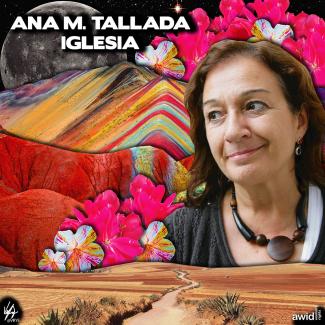
Ana M. Tallada Iglesia

Ana was a strong advocate of women’s rights and worked with a broad cross-section of women, from those in grassroots networks to those in the private sector.

She believed in building bridges across sectors. Ana was a member of the National Network for the Promotion of Women (RNPM), and was active in developing many social programs that address issues such as sexual and reproductive health and rights. 


Ana M. Tallada Iglesia, Peru

كان من المفترض أن أشارك أنا أو مجموعتي في المنتدى الذي تم إلغاؤه بسبب الجائحة، كيف يمكنني المشاركة في هذا المنتدى؟

سنعيد التواصل مع الشركاء/ الشريكات السابقين/ات لضمان احترام الجهود السابقة. إذا تغيرت معلومات الاتصال الخاصة بك منذ آخر عملية للمنتدى، فيرجى تحديثنا حتى نتمكن من الوصول إليك.

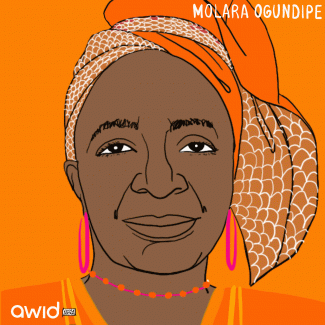
Molara Ogundipe

“But when was the master
ever seduced from power?
When was a system ever broken
by acceptance?
when will the BOSS hand you power with love?
At Jo’Burg, at Cancun or the U.N?
– Molara Ogundipe

In an interview at the 2010 Ghana International Book Fair, Molara Ogundipe introduced herself with the words: “...I’m a Nigerian. I’ve lived possibly all over the world except for the Soviet Union and China.”

Across the different continents and countries, Professor Ogundipe taught comparative literature, writing, gender, and English studies using literature as a vehicle for social transformation and re-thinking gender relations. 

A feminist thinker, writer, editor, social critic, poet, and activist Molara Ogundipe succeeded in combining theoretical work with creativity and practical action. She is considered to be one of the leading critical voices on African feminism(s), gender studies and literary theory.

Molara famously coined the concept of “stiwanism’ from the acronym STIWA – Social Transformations in Africa Including Women recognizing the need to move “away from defining feminism and feminisms in relation to Euro-America or elsewhere, and from declaiming loyalties or disloyalties.”

In her seminal work ‘Re-creating Ourselves’ in 1994, Molara Ogundipe (published under Molara Ogundipe-Leslie) left behind an immense body of knowledge that decolonized feminist discourse and “re-centered African women in their full, complex narratives...guided by an exploration of economic, political and social liberation of African women and restoration of female agency across different cultures in Africa.”

In speaking about the challenges she faced as a young academic she said: 

”When I began talking and writing feminism in the late sixties and seventies, I was seen as a good and admirable girl who had gone astray, a woman whose head has been spoilt by too much learning".

Molara Ogundipe stood out for her leadership in combining activism and academia; in 1977 she was among the founding members of AAWORD, the Association of Women in Research and Development. In 1982 she founded WIN (Women In Nigeria) to advocate for full “economic, social and political rights” for Nigerian women. She then went on to establish and direct the Foundation for International Education and Monitoring and spent many years on the editorial board of The Guardian.

Growing up with the Yoruba people, their traditions, culture, and language she once said :

“I think the celebration of life, of people who pass away after an achieved life is one of the beautiful aspects of Yoruba culture.” 

Molara’s Yoruba ‘Oiki’ praise name was Ayike. She was born on 27 December 1940 and at the age of 78, Molara passed away on 18 June 2019 in Ijebu-Igbo, Ogun State, Nigeria.
كيف يمكنني تمويل مشاركتي في منتدى جمعية حقوق المرأة في التنمية؟

إذا كانت مجموعتك أو مؤسستك تتلقى تمويلًا، فقد ترغب في مناقشة الأمر مع الممول/ة الخاص بك الآن إذا كان قادرًا على دعم سفرك ومشاركتك في المنتدى. تخطط العديد من المؤسسات لميزانياتها للعام المقبل في وقت مبكر من عام 2023، لذا من الأفضل عدم تأخير هذه المحادثة للعام المقبل.

AWID IN 2014: Strengthening Women’s Rights Organizing Around the World

Maritza Quiroz Leiva

Maritza Quiroz Leiva was an Afro Colombian social activist, a community leader and women human rights defender. Among the 7.7 million Colombians internally displaced by 50 years of armed conflict, Maritza dedicated her advocacy work to supporting the rights of others, particularly in the Afro Colombian community who suffered similar violations and displacement.

Maritza was the deputy leader of the Santa Marta Victim's Committee, and an important voice for those seeking justice in her community, demanding reparations for the torture, kidnapping, displacement, and sexual violence that victims experienced during the armed conflict. She was also active in movement for land redistribution and land justice in the country. 

On 5 January 2019, Maritza was killed by two armed individuals who broke into her home. She was 60 years old. 

Maritza joined five other Colombian social activists and leaders who had been murdered just in the first week of 2019. A total of 107 human rights defenders were killed that year in the country. 

هل تختلف عملية التقديم الافتراضية عن عملية التقديم الشخصية؟

ليس هناك اختلاف، نفس الطريقة ونفس الموعد النهائي. يرجى استخدام نفس النموذج لإرسال مقترحك سواء كان ذلك شخصيًا أو عبر الإنترنت أو كليهما (هجين).

Lucy O.

Biography

With over ten years of finance experience, Lucy has devoted her career to for profit and furthering nonprofit missions. She also worked and volunteered at non-for-profit organizations. From the fast-paced world of Finance, Lucy has passion for staying tuned with tech skills in the finance field. Lucy joined AWID in 2014. During her spare time she enjoys music, traveling, and variety sports.

Position
Accounting Coordinator
Add to stories
Off

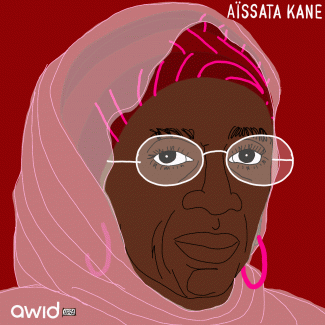
Aïssata Kane

Aïssata Kane, also fondly known as “Yaye Kadia” (Mother Kadia), was a feminist with a lifelong committment in advocating for African and especially Mauritanian women’s rights.

In her career as a politician, she was appointed Minister of Family Protection and Social Affairs in 1975, the first time a woman held such a position and in which Aïssata fervently worked to improve the status of women in her country.  

This work included advancing girls’ and women’s education, fighting against the practice of force-feeding of young women, lobbying for an inclusion of a marital rights provision, and advocating for a female representation quota to be created in the Parliament. 

“[Aïssata] realized all her passions with humility, courage and determination. She didn’t want to disturb anyone by her fight on all these fronts at the same time.” Ball Halimata Dem, Aïssata’s niece

She founded the National Union of Women of Mauritania (UNFM), co-creating and publishing Marienou for them, a magazine dedicated to the emancipation of Mauritanian women. Aïssata also directed several sub-regional and local organizations, including as the President of the International Association of Francophone Women (AIFF) and as a resolute ecologist, she was President of the Association for the Protection of the Environment in Mauritania (APEM). 

In 2018 she received the Pioneer Woman Award. It honors her work in advancing Mauritania’s women’s status and recognizes her strong leadership and sense of innovation.

Aïssata passed away on 10 August 2019. 

เกี่ยวกับวีซ่า

เราตระหนักดีถึงอุปสรรคในทางปฏิบัติและความทุกข์ทางอารมณ์ในการเดินทางระหว่างประเทศ โดยเฉพาะอย่างยิ่งจากซีกโลกใต้ โดย AWID กำลังทำงานร่วมกับ TCEB (สำนักงานส่งเสริมการจัดประชุมและนิทรรศการของประเทศไทย) เพื่อสนับสนุนผู้เข้าร่วมฟอรัมในการขอวีซ่า ข้อมูลอื่นๆเกี่ยวกับการขอวีซ่าจะถูกนำเสนอในช่วงที่เปิดให้ลงทะเบียน รวมถึงสถานที่และวิธีการขอวีซ่า

Claudia Montserrat Arévalo Alvarado

Biography

Claudia is a feminist psychologist with a Masters degree in Development Equality and Equity. She has been a human rights activist for 30 years, and a women’s rights activist for the last 24.

Claudia works in El Salvador as the co-founder and Executive Director of Asociación Mujeres Transformando. For the past 16 years she has defended labour rights of women working within the textile and garment maquila sector. This includes collaborations to draft legislative bills, public policy proposals and research that aim to improve labour conditions for women workers in this sector. She has worked tirelessly to support organizational strengthening and empowerment of women workers in the textile maquilas and those doing embroidery piece-work from home.

She is an active participant in advocacy efforts at the national, regional and international levels to defend and claim labour rights for the working class in the global South from a feminist, anti-capitalist and anti-patriarchy perspective and class and gender awareness raising. She is a board member with the Spotlight Initiative and its national reference group. She is also part of UN Women’s Civic Society Advisory Group. 

Position
Co-President
Add to stories
Off

CFA 2023 - breadcrumbs Menu _ FAQ_en

Jemimah Naburri-Kaheru

Biography

Jemimah Naburri-Kaheru is an accomplished international HR strategist with a profound impact within the Horn of Africa Region. Jemimah previously served as the Regional Human Resource and Office Manager at the Strategic Initiative for Women in the Horn of Africa (SIHA). Her influence extends to HR leadership for over 70 regional staff, as the organization experienced rapid growth with a 40% increase in annual revenues. Throughout her career, Jemimah has orchestrated successful recruitment efforts, introduced merit-based performance systems, and overseen employee relations and HR policies.. She played a pivotal role in supporting global workforce strategies. With an academic background in Development Studies from Makerere University (Uganda) and an ongoing MBA in Human Resource Management, Jemimah's commitment to professional development is evident. Her contribution to high-performance workforces and international HR leadership positions her as an invaluable asset to any global enterprise.

Position
Deputy Director of Human Resources
Add to stories
Off

Snippet - CSW68 - Follow Socials - EN

Follow us!

Through in-person events, lives on our socials, an exhibit booth and more; we are showing up to convene, amplify and support the voices and participation of our members, partners and allies.

Together we will Reclaim Feminist Power by uplifting feminist alternatives and visions around economies that center collective systems of care and nurture both the planet and people.

Follow us on social media for more details on how to participate! Be part of the conversations using the hashtags #AWIDatCSW68 and #ReclaimFeministPower.

Instagram | Facebook | LinkedIn | X (Twitter)

What does AWID do?

Snippet - WITM About the survey - EN

ABOUT THE SURVEY

  • GLOBAL & DIVERSE: Reflecting on resourcing realities of feminist organizing at a global scale and disaggregated by region
  • CONTEXTUALIZED: Centering voices, perspectives and lived experiences of feminist movements in all their richness, boldness and diversity in their respective contexts
  • CO-CREATED: Developed and piloted in close consultations with AWID members and movement partners
  • COMPLEMENTARY: Contributing to and amplifying existing evidence on the state of resourcing for feminist, women’s rights and gender justice organizing by activists, feminist funders and allies
  • MULTI-LINGUAL: Accessible in Arabic, English, French, Portuguese, Russian and Spanish.
  • PRIORITIZING PRIVACY & SECURITY: We are committed to maintaining the confidentiality and integrity of your data. Read our Privacy Policy to learn more about the measures we take to ensure the protection of your information
  • ACCESSIBLE: Accessible to people with a diverse range of hearing, movement, sight, and cognitive abilities, taking approximately 30 minutes to complete
  • REPLICABLE: Replicable by movements in their respective contexts; WITM survey tools and datasets will be publicly available to support more feminist research and collective advocacy.

2002: Discussions on the Financing for Development agenda begin

The Monterrey Conference on Financing for Development marked the beginning of discussions on the Financing for Development agenda.

  • The Monterrey Consensus was adopted at this first international conference on Financing for Development. It was the first United Nations hosted summit-level meeting to address key financial and related issues on global development.
  • The Conference and its preparatory process saw unprecedented cooperation between the United Nations and the World Bank (WB), the International Monetary Fund (IMF) and the World Trade Organization (WTO) as part of efforts to promote greater coherence and consistency among the international monetary, trade and financial systems and institutions.
  • Monterrey also marked the first time that financing for development debates took place between governments, representatives of civil society and the business sector. These actors moved the discussion beyond a ‘technical’ focus, to look at how to mobilize and channel financial resources to fulfill the internationally agreed development goals of previous UN conferences and summits of the 1990s, including the Millennium Development Goals (MDGs).
  • The Women’s Caucus noted the historical significance of the conference stating that it had the potential to address structural challenges that continue to hamper development but also raised concern over the effects of increased militarisation and fundamentalism on women, despite the fact that the Monterrey Consensus assumed that the global economic and financial system worked for all.
  • Learn more about the six Monterrey themes and the conference follow up mechanisms: Gender Issues and Concerns in Financing for Development by Maria Floro, Nilufer Çagatay, John Willoughby and Korkut Ertürk (INSTRAW, 2004) 

Could there be multiple responses to the WITM survey on behalf of a specific group?

No, we are asking for just one completed survey per group.

What is the United Nations Financing For Development Process?

The United Nations (UN) Financing for Development (FfD) process seeks to address different forms of development financing and cooperation. As per the Monterrey Consensus it focuses on six key areas:

  • Mobilizing domestic financial resources for development
  • Mobilizing international resources for development: foreign direct investment and other private flows
  • International trade as an engine for development
  • Increasing international financial and technical cooperation for development
  • External debt
  • Addressing systemic issues: enhancing the coherence and consistency of the international monetary, financial and trading systems in support of development. 

How will you present and process the data collected via the survey?

The data will be processed for statistical purposes to shed light on the state of resourcing for feminist movements globally and will only be displayed in an aggregate form. AWID will not publish information about a particular organization or display information that would allow an organization to be identified by its location or characteristics, without their prior consent.