

Anit-Racism Movement (ARM) / Flickr (CC BY-NC-ND 2.0)

Priority Areas

Supporting feminist, women’s rights and gender justice movements to thrive, to be a driving force in challenging systems of oppression, and to co-create feminist realities.

Resourcing Feminist Movements

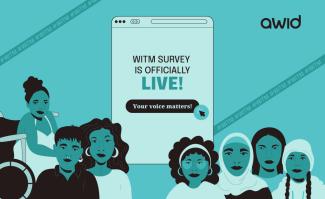
Banner image announcing that WITM Survey is live.


The “Where is the Money?” #WITM survey is now live! Dive in and share your experience with funding your organizing with feminists around the world.

Learn more and take the survey


Around the world, feminist, women’s rights, and allied movements are confronting power and reimagining a politics of liberation. The contributions that fuel this work come in many forms, from financial and political resources to daily acts of resistance and survival.


AWID’s Resourcing Feminist Movements (RFM) Initiative shines a light on the current funding ecosystem, which range from self-generated models of resourcing to more formal funding streams.

Through our research and analysis, we examine how funding practices can better serve our movements. We critically explore the contradictions in “funding” social transformation, especially in the face of increasing political repression, anti-rights agendas, and rising corporate power. Above all, we build collective strategies that support thriving, robust, and resilient movements.


Our Actions

Recognizing the richness of our movements and responding to the current moment, we:

  • Create and amplify alternatives: We amplify funding practices that center activists’ own priorities and engage a diverse range of funders and activists in crafting new, dynamic models  for resourcing feminist movements, particularly in the context of closing civil society space.

  • Build knowledge: We explore, exchange, and strengthen knowledge about how movements are attracting, organizing, and using the resources they need to accomplish meaningful change.

  • Advocate: We work in partnerships, such as the Count Me In! Consortium, to influence funding agendas and open space for feminist movements to be in direct dialogue to shift power and money.

Related Content

Por que devo considerar responder ao inquérito?

Existem várias razões pelas quais a sua resposta ao inquérito WITM é importante. Por exemplo, tem a oportunidade de partilhar a sua experiência vivida com a mobilização de financiamento para apoiar a sua organização; de reivindicar o seu poder como especialista sobre como o dinheiro circula e os bolsos em que entra; e de contribuir para a defesa coletiva e consistente junto de financiadores para mover mais recursos de maior qualidade. Ao longo das últimas duas décadas, o inquérito WITM da AWID tem-se revelado um recurso fundamental para ativistas e financiadores. Convidamo-lo a juntar-se a nós na sua terceira edição para destacar o estado efetivo do financiamento, desafiar soluções falsas e apontar a forma como o financiamento precisa de mudar para que os movimentos prosperem e enfrentem os desafios complexos do nosso tempo.

Pleasure(s) as the key to personal freedom

By Nkhensani Manabe

The conversation title "Pansexual, Gynasexual or Abrosexual? A dive into queerness, pleasure and sex positivity" gives one much to think about. Tiffany Kagure Mugo, author, educator and curator of HOLAAfrica, begins the discussion with a reading from Touch, a recently published collection of fiction and non-fiction essays on sex, sexuality and pleasure. In this excerpt, the author puts forward the idea that pleasure is constant and ongoing, it is to be found in everyday activities and is not confined to sexual intercourse.

This idea, that pleasure is as much a part of daily life as anything else, runs through the discussion, which also covers topics of desire, attraction and sexual orientation.

Pleasure Garden exhibition: the photographic and illustrative collaboration produced by Siphumeze and Katia

Early on, there is this sense of hope and possibility. Tiffany presents options and explains alternatives, giving us new language to speak about who we are, what we like, and how we want it. This is about desire and sex, but mostly it is about self-knowledge and empowerment. Tiffany speaks passionately about making decisions from a place of power: learning your own identity so that you are able to make the best choices for yourself. 

In a conversation that is open and free, representing the attitude that Tiffany would have us all adopt, we learn that knowledge about sex and sexuality is ever-changing, the boundaries are shifting. What we may have learned or, more importantly, been kept away from as children or adults is exactly where we should start unlearning and reprogramming. Tiffany notes that young people these days need tools to understand the experiences they are already having, a reminder to never underestimate what children and teenagers know about the kind of pleasure(s) they want to pursue in life.

The conversation opened my mind to something: knowing myself will help to build my confidence; I will be able to approach relationships with care not only for myself but for others, too. Learning the language of orientation, attraction, desire and pleasure will go towards deepening my future connections. I appreciated the space to think about this aspect of my life -- the private, intimate parts that I don’t access often. Tiffany’s enthusiasm about pleasure and identity pushed my own boundaries, allowing me to entertain new personal possibilities. 

The idea of learning how to make holistic connections is still not common. Largely, we live in a culture of instant and fleeting connections. There is hardly any time to truly reflect on how and why we are seeking relationship or partnership -- at least, not until a moment of crisis. 

Of course, there are selected spaces that welcome questions and discussions, such as the AWID Crear Résister Transform Festival and other free-thinking online platforms or publications -- but access to information from a helpful, non-judgemental source is something people are still trying to figure out. This may be in part because people are not confident in the language of sexuality and pleasure. 

Sex and Spirtuality
Pleasure Garden exhibition: the photographic and illustrative collaboration produced by Siphumeze and Katia

The notion of language and tools repeats itself throughout Tiffany’s presentation. Tiffany and her colleagues are doing the work of talking, teaching and nurturing. Seeing what people need, where they are, what they want for themselves, and walking alongside them as they build their ideal worlds. Giving them new words and definitions to help give shape to their identities at different stages of their lives. 
These are the kinds of conversations that are necessary, even in a society that has myriad healthcare messages broadcast with varying degrees of details at any given moment. Sometimes people need to be brought back from the big picture moments and encouraged to learn about their individual opinions and desires. This is what Tiffany’s talk does: it gives people a space in the larger puzzle. 

A highlight of Tiffany’s talk was the section on the different types of attraction. 

Sexual -- as in, the express desire to have intercourse with a person or people
Sensual -- the desire to touch a person or people, to be physically close without necessarily including intercourse
Romantic -- the desire to date or be in a relationship with a person or people
Platonic -- the desire to build close friendships 
Aesthetic -- the desire to look at and be pleased by the appearance of a person or people

These five types or levels of attraction offer a shorthand for desire and pleasure, and help to contextualise the different kinds of pleasure people can experience. 

Thinking of attraction beyond the physical or sexual offers a new perspective on connection. It is a chance to take the pressure off relationships, which opens up opportunities for different, more enlightened and fulfilling partnerships. 

This freedom and knowledge that Tiffany presents is a roadmap to the future. The presentation offered a new perspective on what is possible. 

As the opening excerpt states, pleasure is ongoing. In light of Tiffany’s discussion, it is also clear that it is dynamic and exciting. There is always more to know. 

This may be daunting at first, but on the other side of hesitation is hope, potential and freedom. 

نحن نعيد إعطاء المال لشركائنا/شريكاتنا ونعرّف عن أنفسنا كنسويات و\ أو صندوق نسائي. هل علينا تعبئة الاستطلاع؟

كلا. نقدّر عملكم/ن لكننا لا نطلب في هذه المرحلة من الصناديق النسوية والنسائية تعبئة الاستطلاع. نشجعكم/ن على مشاركة الاستطلاع مع شركائكم/ن و شبكاتكم/ن النسوية.

We Are the Ones We Have been Waiting For!

We’re beginning a new year--2023. COVID-19 continues to infect and re-infect many, many people around the world. We are witnessing the resurgence of right-wing and fascist governments, even in places we may not have expected like Sweden. War, armed conflict, and dramatic increase in militarization, militarism, and military spending are enabling the unbridled capital accumulation by the few, with participation of seemingly “strange” alliances locking arms, both visibly and invisibly, where economic and political elites of the Global North and Global South are benefitting beyond our wildest imagination. In the meanwhile, our people and the natural environment pay enormous costs and suffer all the expected and unexpected consequences.

As all of you and all of us at AWID know, feminists in multiple movements around the world are resisting and organizing against multiple faces of tyranny, creating alternative structures, implementing grassroots strategies, and building transnational alliances. We are generating joy, inspiring one another, singing, and dancing within and against the prevailing culture of killing and cynicism that seems to have engulfed so much of the world.

We--Staff and Board--of AWID are prepared and inspired more than ever before to face challenges by strengthening our relationships with our members and organizational partners, meeting and getting to know those who we are yet to meet and do what we do best: support the global feminist movements. Although we were sad facing the departures of our beloved former Co-Eds Cindy and Hakima, our wonderful new Co-EDS Faye and Inna along with committed and creative staff have embraced the moment that encapsulates both opportunities and threats.

For sure, all of us at AWID and all our movement folks know:  As the Caribbean US poet and activist June Jordan wrote to the South African women activists during the height of the apartheid regime, “We are the ones we have been waiting for”!

На каких языках проводится опрос?

На данный момент опрос в KOBO доступен на арабском, английском, французском, португальском, русском и испанском языках. В начале опроса у вас будет возможность выбрать нужный вам язык.

Donation Success


Thank you for taking a step further to change the world!

Your generous contribution will help us support feminist movements across the globe working to achieve gender justice and women’s human rights worldwide.

You can also support our work as an AWID Member. Find out how here.

Devo fazer alguma preparação para responder ao inquérito?

Tendo em conta que o inquérito WITM foca-se nas realidades do financiamento de organizações feministas, a maioria das perguntas aborda o tópico do financiamento do seu grupo entre 2021-2023. Será preciso ter essas informações facilmente acessíveis para preencher o inquérito (por exemplo, os seus orçamentos anuais e as principais fontes de financiamento).

هل مشاركتي سريّة؟

أكيد. سيتم محي اجوبتك بعد عملية معالجة المعطيات وتحليلها وسيتم استعمالها لأهداف بحثية فقط. لن تتم أبداً مشاركة المعطيات خارج AWID وسيتم معالجتها فقط عن طريق طاقم AWID والمستشارات/ين اللواتي/ اللذين يعملن/وا في مشروع "أين المال" معنا. خصوصيتكم/ن وسرّيتكم/ن هي في أعلى سلم أولوياتنا. سياسة الخصوصية متواجدة هنا.

Как долго будет доступен опрос?

Опрос будет доступен до конца августа 2024 года. Пожалуйста, заполните его в течение этого срока, чтобы ваши ответы были включены в анализ.

Snippet - Home page promo WITM - EN

"Where is the money for feminist organizing?"

Building on our 20-year history of mobilizing more and better funding for feminist-led social change, AWID invites you to complete the new iteration of our flagship survey, WITM.

START THE SURVEY Learn more

Snippet - Rights and Resources - EN

Rights and Resources:
Getting Ready for the Next 30 Years

✉️ In-person registration is now closed. Sign up for the livestream here

📅 Wednesday, March 12, 2025
🕒 12.00-1.30pm EST

🏢 UNDP, 304 E 45th St. Doha Room, 11th Floor (FF Building)

Organizers: UNDP, Femena, SRI and AWID

Snippet - GenderJobs.org

Logo for website GenderJobs.org

GenderJobs.org: This is a platform with a comprehensive list of job opportunities to work on gender equality and LGBTQI+ rights, curated by gender professionals and intersectional feminists who intimately know the sector and are extremely passionate about supporting other gender professionals and anyone who is aspiring to become one! (source: https://genderjobs.org/about)

Snippet - WCFM Database blurb 2 - En

Know a Funder? Add them to the Database!

Are you a funder? Or do you know funders that support feminist and gender justice movements? Apply to be a part of the Who Can Fund Me? Database now!

Join the database

sinppet-annual-budget-size-4-4

Key factors impacting 
budget size

→Region
→Level of organizing
→Registration status
→Priorities and Agendas


Read and download the insights here

Snippet - COP30 - Actions - EN

COP30 Events and Actions

08 - 16 November, 2025

Snippet - COP30 - Mutual Aid and Community Care - EN

AWID Member Exclusive: Mutual Aid and Community Care Crafting Workshop

AWID members will explore and critically evaluate the role that mutual aid can play in resourcing our movements, through collective collage making.

📅 Wednesday, November 12, 2025
📍 The People’s COP Space

More info here

Human Rights Council (HRC)

The Human Rights Council (HRC) is the key intergovernmental body within the United Nations system responsible for the promotion and protection of all human rights around the globe. It holds three regular sessions a year: in March, June and September. The Office of the UN High Commissioner for Human Rights (OHCHR) is the secretariat for the HRC.

The HRC works by:

  • Debating and passing resolutions on global human rights issues and human rights situations in particular countries

  • Examining complaints from victims of human rights violations or activist organizations on behalf of victims of human rights violations

  • Appointing independent experts (known as “Special Procedures”) to review human rights violations in specific countries and examine and further global human rights issues

  • Engaging in discussions with experts and governments on human rights issues

  • Assessing the human rights records of all UN Member States every four and a half years through the Universal Periodic Review

Learn more about the HRC


AWID works with feminist, progressive and human rights partners to share key knowledge, convene civil society dialogues and events, and influence negotiations and outcomes of the session.

With our partners, our work will:

◾️ Monitor, track and analyze anti-rights actors, discourses and strategies and their impact on resolutions

◾️ Raise awareness of the findings of the 2017 and 2021 OURs Trends Reports.

◾️Support the work of feminist UN experts in the face of backlash and pressure

◾️Advocate for state accountability
 
◾️ Work with feminist movements and civil society organizations to advance rights related to gender and sexuality.
 

Related Content

Sans frontières ni barrières

Sans frontières ni barrières

« Ne cessez jamais de vous battre parce que la lutte n’est pas finie ; elle vient juste de commencer. » – Marianna Karakoulaki

Depuis l’été 2005, Idomeni, un village situé à la frontière gréco-macédonienne, est progressivement devenu le plus vaste camp officieux de réfugié-e-s de Grèce. À la fin du mois de mai, ce camp a été fermé par les autorités. Et depuis maintenant un an, Marianna Karakoulaki, une jeune journaliste indépendante originaire d’une petite ville du nord-ouest du pays, couvre les événements qui se produisent dans ce village.
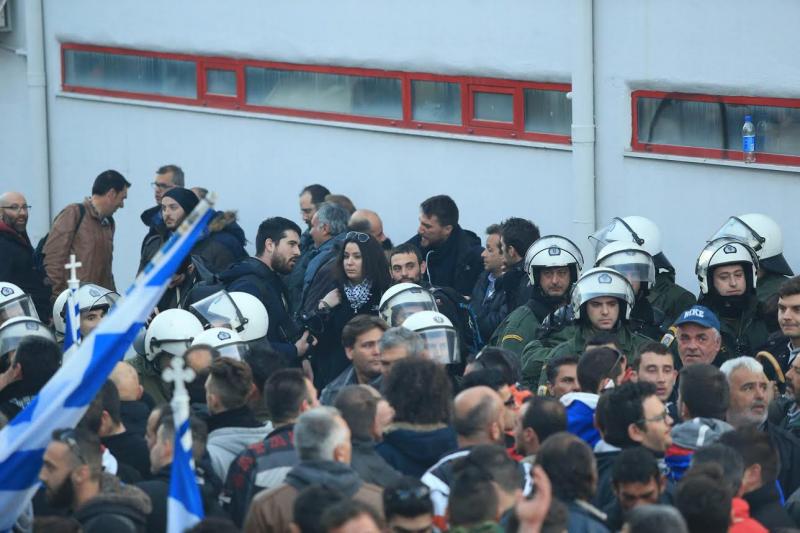
 

Accompagnée par des collègues derrière la police anti-émeute grecque durant une manifestation à Thessalonique

Marianna a aussi couvert les manifestations et les émeutes qui se sont déroulées principalement à Thessalonique, la ville où elle vit depuis quelques années. Outre le travail qu’elle effectue pour différents médias, dont Deutsche Welle (DW), IRIN News et the Middle East Eye, elle réalise également des reportages pour la télévision. Elle a récemment co-réalisé un reportage d’actualité, Macedonia: Tracking down the refugee kidnap gangs (Macédoine : sur la trace des gangs qui kidnappent les réfugiés, en anglais), qui a remporté plusieurs prix dont celui  du meilleur reportage d’actualité pour la télévision décerné par l’Association de la presse étrangère à Londres.

Le féminisme, un fil rouge

« Je me sens absolument féministe, sans aucune réserve. Mon féminisme fait partie de mon identité, tout comme mon athéisme et mes convictions politiques de gauche. »​ – Marianna Karakoulaki

Le féminisme a été le fil rouge de la vie, de l’éducation et du travail de Marianna. Elle a l’impression « de s’être toujours sentie féministe, même quand elle ne savait pas encore vraiment ce que ce mot signifiait », et ce depuis son adolescence et tout au long de ses études de master en sécurité internationale à l’université de Birmingham, au Royaume-Uni. Pendant les épisodes dépressifs occasionnels qu’elle a connu et pendant toutes ses années d’études des mouvements et de la lutte pour l’égalité, le féminisme l’a inspirée et lui a permis d’adopter une nouvelle approche « d’à peu près tout ».

« Il [le féminisme] a entièrement changé mon orientation académique, mon idéologie politique et mon approche de la vie au sens large. C’est la raison pour laquelle je porte toujours autour du cou le poing féministe. » - Marianna Karakoulaki
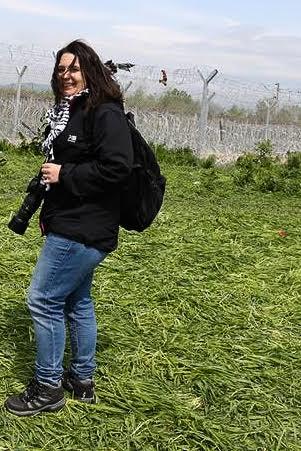
Pendant une manifestation à la frontière greco-macédonienne à côté d’une clôture macédonienne nouvellement construite

Dans le cadre de son travail, Marianna tente de se consacrer aux questions féministes en donnant la possibilité à celles qui sont reléguées à la marge de s’exprimer, notamment en Grèce où « les questions relatives au genre sont soit ignorées soit insuffisamment prises en charge ».

Elle travaille  depuis un an sur la crise des réfugié-e-s, mais elle a délibérément évité d’écrire un article sur les femmes réfugiées.

« J’ai pris cette décision tout d’abord parce que je ne voulais pas faire intrusion dans la vie de ces femmes dans le simple but de dénicher une bonne histoire. J’ai entendu des récits qui auraient méritées d’être publiées mais, sans vraiment savoir pourquoi, je ne me suis jamais sentie autorisée à raconter la vie de ces personnes dans telle situation de vulnérabilité. Il faut que leurs voix soient entendues, mais il y a un bon moment pour le faire, et je pense qu’il faut attendre qu’elles atteignent enfin un espace sûr dans laquelle leur protection est assurée. »  - Marianna Karakoulaki

Quelques informations complémentaires sur Marianna

Dans le cadre académique, elle est membre de l’équipe de direction et de rédaction de E- International Relations (E-IR), un site académique pour lequel elle dirige la publication d’un livre sur les migrations au XXIe  siècle, à paraître fin 2016. Marianna a également dispensé des cours lors de différents ateliers organisés en Grèce sur l’égalité de genre, les questions de genre et la diversité des féminismes. Elle a également écrit des articles sur le droit à l’avortement notamment aux États-Unis mais aussi sur les questions féministes ou relatives aux femmes dans le Moyen-Orient.


Marianna explique comme suit sa décision de devenir membre de l’AWID :


« Je suis devenue membre de l’AWID parce qu’il s’agit d’une organisation dont les domaines d’action prioritaires sont très proches de mon idéologie et de mes préoccupations et qui donne la parole aux personnes du monde entier que l’on entend jamais, et j’aime beaucoup cela. »  

À la question « quel changement aimeriez-vous voir se matérialiser de votre vivant ? », Marianna apporté cette réponse :

« Si je devais choisir un changement que j’aimerais voir survenir de mon vivant, ce serait l’instauration d’une égalité issue d’une approche venue de la base ; cela demandera du temps, des efforts et du dévouement. Cela exigera également une refonte des tactiques et stratégies des mouvements. Je fais aussi le rêve utopique d’un monde sans nations ni frontières fondé sur l’auto-organisation, mais je crains que cela ne soit pas possible. »

Pour en savoir plus sur Marianna, n’hésitez pas à consulter son site internet (en anglais)

Region
Europe
Source
AWID

Without Borders and Barriers

Without Borders and Barriers

“Don’t give up fighting because the struggle is not over; it has just begun”. – Marianna Karakoulaki

Since the summer of 2015, Idomeni, a village at the Greek-Macedonian border, has increasingly turned into a site of the largest unofficial refugee camp in Greece. At the end of May it was shut down by authorities. For a year now, Marianna Karakoulaki, a young woman originally from a small town in the north-western part of the country has been covering the refugee crisis in Idomeni as a freelance journalist. 

With colleagues behind Greek riot police during a protest in Thessaloniki, Greece

Marianna has also been covering social protests and riots, mostly from Thessaloniki where she has been living for the past couple of years. Reporting for several media outlets, including Deutsche Welle (DW), IRIN News, and the Middle East Eye, she additionally produces TV reports, recently being part of a  Channel 4 News production: Macedonia: tracking down the refugee kidnap gangs which has won several awards including ‘TV News Story of the Year’ from Foreign Press Association in London.

Feminism, a red thread

“I absolutely and without any doubt identify as a feminist, it’s part of my identity along with being an atheist and a leftist.” – Marianna Karakoulaki

Throughout Marianna’s experiences, education and work, feminism has been a red thread throughout her life. She feels she has “always identified with feminism, without actually knowing what it was”, from her teen years and all through her Master’s degree studies in International Security at the University of Birmingham, United Kingdom. Marianna has countered occasional bouts of depression, and alongside studying about movements and the struggle for equality, feminism has inspired and given her a new approach to “pretty much everything”.

“It [feminism] entirely changed my academic focus, political ideology, and general approach to life. That is the reason I always wear a necklace with the feminist fist.” - Marianna Karakoulaki

During a protest at the Greek-Macedonian border next to the newly built Macedonian fence

In her work, Marianna tries to focus on feminist subjects aiming to give voice to those on the margins especially in Greece seeing “gender related issues are either ignored or not covered as they should be.”  

But even though she has been reporting about the refugee crisis for the past year, she has been, as she tells us, deliberately avoiding writing a story on refugee women.

“The main reason for that is that I don’t really want to intrude in refugee women’s lives just for the sake of a good story; I have heard some stories that would have been worth publishing, but for a reason it never felt right as these people are in a vulnerable position. Their voice needs to be heard but there is the right moment for that and for me this is when they finally reach a safe space where they are protected.” - Marianna Karakoulaki

A bit more about Marianna

In her current academic work, she is one of the directors and editors of E- International Relations (E-IR), an online academic publication, where she is currently editing a book on migration in the 21st century due to be published in late 2016. Marianna has also taught at several workshops in Greece on gender equality, gender issues, and the diversity of feminisms and has written papers and articles on abortion rights specifically in the United States of America, as well as about feminist and women’s issues in the Middle East.

Marianna joined AWID as a member because:

“I joined AWID as it’s an organization where its priority areas are very close to my ideology and focus, plus it is giving a voice to those in parts of the world that cannot be heard, and I like that.”

And in answer to the question “what change would you like to see in your lifetime?” Marianna responded:

“If I had to choose a change that I’d like to see in my lifetime, that would be equality that will come from a bottoms-up approach; that will demand time, effort, and devotion. It will also demand a re-approach of the movements’ tactics and strategy. I also have a utopian dream of a world without nations and borders based on self-organisation, but that is rather impossible.”

To find out more about Marianna, please visit her website

Region
Europe
Source
AWID

Sin límites ni barreras

Sin límites ni barreras

«No dejen de pelear porque la lucha no ha terminado: recién empieza.» – Marianna Karakoulaki

Desde el verano (boreal) de 2015, Idomenei, un pueblo ubicado en la frontera entre Grecia y Macedonia, albergó el campamento no oficial de personas refugiadas más grande de Grecia. A fines de mayo de 2016, las autoridades lo cerraron. Desde hace ya un año, Marianna Karakoulaki, una joven originaria de otra ciudad pequeña pero en el noroeste del país, ha venido cubriendo la crisis de las personas refugiadas en Idomenei como periodista independiente. 

Con colegas tras la policía en una protesta en Thessaloniki, Grecia

Marianna también ha cubierto protestas y levantamientos sociales, en particular desde Thessaloniki donde vivió durante los últimos años. Es corresponsal de varios medios como Deutsche Welle (DW), IRIN News, y Middle East Eye. Además, produce informes para la televisión y recientemente intervino en una producción de Channel 4 News: Macedonia: tracking down the refugee kidnap gangs [En la pista de las bandas que secuestran refugiadxs en Macedonia; en inglés] que obtuvo varios premios, entre ellos el de cobertura noticiosa del año en televisión otorgado por la Asociación de Prensa Extranjera en Londres. 

Feminismo, un hilo conductor rojo    

 «Me defino como feminista, absolutamente y sin ninguna duda. Es parte de mi identidad, al igual que ser atea y de izquierda.»  – Marianna Karakoulaki

El feminismo ha sido un hilo conductor rojo que recorre todas las experiencias, la formación y el desempeño laboral de Marianna a lo largo de su vida. Considera que: «desde siempre me he identificado con el feminismo, sin saber qué era», ya en su adolescencia y durante sus estudios de Maestría en Seguridad Internacional en la Universidad de Birmingham, Reino Unido. Marianna hizo frente a crisis depresivas esporádicas y además de estudiar los movimientos y las luchas por la igualdad, el feminismo la ha inspirado y le ha aportado un nuevo enfoque «prácticamente sobre todas las cosas».

«El feminismo cambió por completo mis prioridades académicas, mi ideología política y mi enfoque sobre la vida en general. Por eso siempre llevo puesto un colgante con el puño feminista.»  - Marianna Karakoulaki

Durante una protesta en la frontera entre Grecia y Macedonia cerca de la recientemente construida barrera fronteriza macedonia

En su trabajo, Marianna intenta abordar temáticas feministas para hacer que se escuchen las voces de los márgenes sobre todo en Grecia  «ya que los temas de género son ignorados o no se los cubre como se debería».

Pero aunque lleva más de un año informando sobre la crisis de las personas refugiadas ha tratado, en forma deliberada, de evitar escribir sobre las mujeres refugiadas. 

 «La razón principal es que no quiero entrometerme en las vidas de las mujeres refugiadas solo para obtener una buena nota; escuché algunas historias dignas de ser publicadas, pero nunca sentí que fuera apropiado hacerlo porque son personas en una posición de vulnerabilidad. Es necesario que se escuchen sus voces pero hay un momento adecuado para hacerlo y para mí ese momento será cuando por fin lleguen a un espacio seguro donde estén protegidas.» - Marianna Karakoulaki

Un poco más acerca de Marianna

En su trabajo académico actual, es una de las directoras y editoras de E- International Relations [Relaciones internacionales electrónicas; E-IR], una publicación académica en línea para la que está editando un libro sobre migraciones en el siglo XXI que se publicará este año. Marianna también ha dictado varios talleres en Grecia sobre igualdad de género, otras temáticas de género y la diversidad de los feminismos. Escribió artículos académicos y periodísticos sobre el derecho al aborto en Estados Unidos así como sobre temáticas feministas y de mujeres en Medio Oriente.

Marianna se afilió a AWID porque:

«...es una organización cuyas áreas prioritarias son muy afines a mi ideología y a lo que yo priorizo. También porque le da voz a quienes viven en zonas del mundo desde las que no pueden ser escuchadas, y eso me gusta.»

En respuesta a la pregunta sobre qué cambios le gustaría ver en su vida, Marianna afirmó:

«Si tuviera que elegir un cambio que quiero ver en mi vida, sería una igualdad producto de un enfoque ‘desde abajo hacia arriba’. Eso llevará tiempo, esfuerzo y dedicación, así como una revisión de las tácticas y la estrategia de los movimientos. También tengo el sueño utópico de un mundo sin naciones ni fronteras, cuya base sea la organización autónoma, pero eso es bastante imposible.»

Para saber más sobre Marianna, por favor visita su sitio de Internet [en inglés]

Region
Europa
Source
AWID