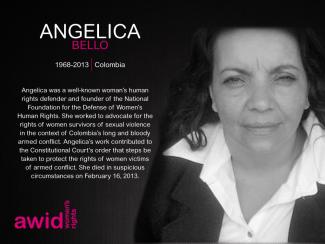
Angelica Bello
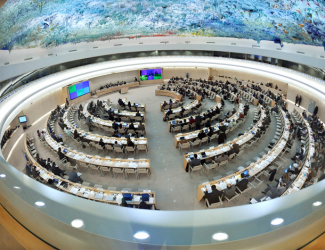
El Consejo de Derechos Humanos (CDH) es el cuerpo intergubernamental del sistema de las Naciones Unidas responsable de la promoción y protección de todos los derechos humanos en todo el mundo. El HRC se reúne en sesión ordinaria tres veces al año, en marzo, junio y septiembre. La La Oficina del Alto Comisionado para los Derechos Humanos (ACNUDH) es la secretaría del Consejo de Derechos Humanos.
Debate y aprueba resoluciones sobre cuestiones mundiales de derechos humanos y el estado de los derechos humanos en determinados países
Examina las denuncias de víctimas de violaciones a los derechos humanos o las de organizaciones activistas, quienes interponen estas denuncias representando a lxs víctimas.
Nombra a expertos independientes que ejecutarán los «Procedimientos Especiales» revisando y presentado informes sobre las violaciones a los derechos humanos desde una perspectiva temática o en relación a un país específico
Participa en discusiones con expertos y gobiernos respecto a cuestiones de derechos humanos.
A través del Examen Periódico Universal, cada cuatro años y medio, se evalúan los expedientes de derechos humanos de todos los Estados Miembro de las Naciones Unidas
Se está llevarando a cabo en Ginebra, Suiza del 30 de junio al 17 de julio de 2020.
AWID trabaja con socios feministas, progresistas y de derechos humanos para compartir conocimientos clave, convocar diálogos y eventos de la sociedad civil, e influir en las negociaciones y los resultados de la sesión.
La cocréation de nos réalités féministes commence par nous-mêmes, et nos façons de nous traiter les un·e·s les autres. Nous nous efforçons de créer et de protéger des espaces qui sécurisent et soutiennent nos communautés, à la fois en ligne et en personne.
Nous envisageons aussi les espaces sécurisés et accueillants, tout comme cocréés, et dont la possession est partagée. Nous attendons de nos membres qu'iels agissent de façon éthique, responsable et cohérente vis-à-vis des valeurs de l’AWID, et qu'iels assument une responsabilité collective pour garantir un environnement de respect mutuel et de solidarité.
Remarque :
L’AWID se réserve le droit de supprimer des commentaires, suspendre ou révoquer l’adhésion de membres en cas de violation des règles de la communauté. Les membres de l’AWID ne sont pas autorisés à représenter l’AWID à titre officiel, sauf mention écrite contraire. Les membres ne peuvent pas utiliser les espaces de l’AWID à des fins de prosélytisme ou de recrutement de membres pour rejoindre une organisation ou une croyance religieuse. Les membres ne peuvent pas utiliser les espaces de l’AWID pour demander des fonds à des fins personnelles, bien que les liens vers des actions de levée de fonds ou des campagnes de mobilisation soit autorisés.
كلا. نطلب فقط تعبئة استطلاع واحد لكل مجموعة.
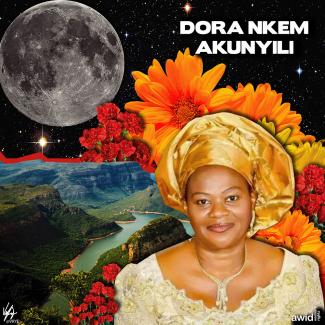
Dora nació en el estado de Benue, Nigeria. Fue una farmacéutica, tecnócrata, investigadora erudita y líder comunitaria reconocida mundialmente.
El trabajo revolucionario de Dora produjo un cambio de paradigma en el servicio público nigeriano cuando se desempeñó como Directora General de la Agencia Nacional para la Administración y Control de Alimentos y Medicamentos, entre 2001 y 2008. Encabezó reformas en la aplicación de políticas y regulaciones que redujeron drásticamente la cantidad de drogas falsas que asolaban el sector farmacéutico nigeriano cuando asumió su cargo.
Se convirtió en un ícono del empoderamiento de las mujeres, porque fue un ejemplo real de mujer valiente y competente que desafió los males de una sociedad predominantemente patriarcal. Fue nombrada Ministra de Información y Comunicación entre 2008 y 2010.
Murió luego de una batalla contra el cáncer, y le sobreviven su esposo, seis hijxs y tres nietxs.
Most Member States of the European Union have laws and practices that either criminalize or control sex workers in ways unacceptable to them. Criminalization of sex workers and/or their clients only contributes to increase the vulnerability of sex workers, who are already facing stigma, discrimination and exclusion from society on a daily basis. In Spain for example, the government is currently trying to pass an Organic Law for the Abolition of Prostitution, which will result in more clandestiny and violence. Let’s dive into the stories of sex workers and union organizers fighting to decriminilaze sex work and advance their labor rights.
We believe in a full application of the principle of rights including those enshrined in international laws and affirm the belief that all human rights are interrelated, interdependent and indivisible. We are committed to working towards the eradication of all discriminations based on gender, sexuality, religion, age, ability, ethnicity, race, nationality, class or other factors.
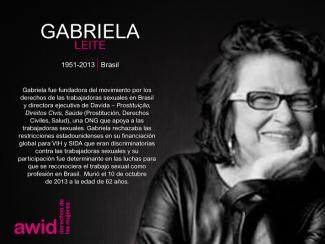
By Alejandra Laprea
What a difficult task, that of condensing all the power and diversity of voices being raised in Latin America to tell the other stories emerging in this vast territory, to speak of the feminist realities we are building in our movement and other community-based organizations.
I spent a long time trying to establish parameters for the search and selection of these films, with the idea that they would enable you to get a little closer to so many dreams and projects that are slowly coming into being in the territories Nuestroamericanos, of our Americas, as we like to call them ourselves. It was a tough job trying to establish parameters, such as geographic location, linguistic justice, and representation of diverse communities — Indigenous, Afro-descendants, migrants — and the many causes and claims for which they raise their voices. I arrived at the conclusion that making such a compilation would be the work of years, one of those projects always under construction.
And so I decided to search for works that have emerged out of organizing and activism, as well as films that will perhaps spark major debates that we are yet to have.
In this selection of films you will find the voices of filmmakers who are not content with simply recording the feminist realities that palpitate in every corner of this vast and diverse territory. These are works that from their very conceptualization are questioning for what, by whom, and how films and videos are made. They understand film to be an instrument of struggle, something more than images to be enjoyed on a screen. These are individual or collective filmmakers who see film and video making as an instrument to promote discussion, open a debate, and thus serve as a resource for popular and feminist pedagogies.
Seen in this light, this small film selection is a journeythrough feminist realities on two levels; on one level are the stories you will see, and on another level, there is the experimentation of filmmakers who are seeking and creating other feminist realities through the ways in which they are making films and telling stories.
Enjoy this journey through films that Resist, Create, and Transform.
Direction: Giovana García Soto
Docu-fiction
Spanish with English subtitles
In Lima is Burning our work plays with documentary and fiction to take us into the life of Gía, a non-binary person, who uses performance art as a tool to denounce and transgress, as a vital manifesto against transfobia in every space, including gays spaces. With Gía we also take a look at transfeminism as a safe community in which Gía feels embraced, where she shares feelings and affections.
Giovana Garcia Sojo is a young peruvian audiovisual producer, specialized in low-budget production, creation for children and adolescents in cinema and cinematographic script by the International School of Cinema and Television - EICTV in San Antonio de Baños - Cuba. Giovana has developed her path as a director towards women and feminized identities, Lima is Burning is one of her first works.
Director: Patricia Ortega
Fiction
Spanish with English subtitles
Patricia Ortega, director of «Yo, Imposible» [“Being Impossible”] explores through the character of Ariel, a young girl whose intersex body was surgically violated as a child, the many ways that society attempts to normalize sexual and gender diversity.
The film tells the story of how Ariel discovers she was born intersex and subjected to several surgeries to normalize her genitals. This discovery leads the character to rediscover her body and reconstruct her identity. The audience is led to question a society dominated by heteronormativity which renders others invisible and condemns them to a life of unhappiness.
Patricia Ortega is a Venezuelan filmmaker living in Argentina who studied at the International School of Film and Television in Cuba, where she specialized in film directing. Patricia uses fiction to address extreme situations that women or feminized bodies go through, and how they overcome them.
«Yo, Imposible»' takes a position vis-à-vis the dominant conception of a world in which only the masculine and feminine exist, which makes others invisible. “They are not sick. They are just genetically different. Interventions are done on their genitals and bodies through hormones without their consent, which is a violation of their human rights and identity, forcing them to fit into established categories'' - Patricia Ortega
Director: Maria Torrellas Liebana
Documentary
Spanish with English subtitles
María Torrellas narrates the story of the Cuban Revolution through the women who brought it to life, Vilma Espín, Celia Sánchez, and Haydee Santamaría, among others.
For women, telling the story of the Cuban Revolution is not something of the past, but a daily struggle that Torrellas shows through the voices of Cuban rural women, professionals, students, and workers in the present. In “Cuban Women in Revolution” we encounter the current challenges facing Cuban women such as the persistence of old prejudices, new forms of violence, and the constant challenge of creating new feminist realities for themselves and the next generations in a territory besieged by USA imperialism for more than 70 years.
María Torrellas is a journalist and documentary filmmaker. She has a long trajectory of filmmaking and has won, among others, the Santiago Alvarez in Memoriam award for her documentary “Memoria de una hija de Oshun” [Memory of a Daughter of Oshun].
“In the documentary I have woven together the struggles of yesterday’s heroines with those of today’s women. The women tell their own stories and also describe those whose struggles they most admire. It made an impression on me to hear the words ‘The Revolution gave us everything’ or ‘What would have become of my family without the Revolution?’ from voices of compañeras who are poor, rural, or Black.” - María Torrellas
Directors: Gabriela Arnal and Marzel Ávila for Fondo de Acción Urgente - LAC
Ecuador 2019
Spanish with English subtitles
CUIDANDERAS joins the words cuidar (to care for) and curanderas (women healers) synthesizing the identities of a series of women in Latin American territories, women who put their bodies and all their energy into protecting the Commons, what Pachamama gives us, with the commitment that we use it as wisely as the rest of living beings doThis mini series of documentary films presents the stories of three collectives of Latin American women who are committed to caring for their territories, healing their bodies, and confronting extractivist and racist projects in Ecuador, Colombia, and Bolivia.
Province of Orellana, Ecuador. For centuries the Waorani women have been engaged in a struggle for their territory in the Amazon and the preservation of their Indigenous culture. Today they confront threats by the oil industry and their death-production model. From the jungle, leaders from the Waorani Women’s Association of the Ecuadoran Amazon (AMWAE, in Spanish) share the motivation behind their resistance and show their greatest power: their inexhaustible joy.
Buenaventura, Colombia. In the largest and most violent port city in Colombia, plagued by decades of armed conflict, racism, and machismo, a group of women refuse to give in to fear and continue to resist in the face of adversity. The Butterflies with New Wings network is made up of Black women from the Pacific coast of Colombia who work together to protect their territory, recuperate their ancestral traditions, and heal the wounds of systematic and structural violence.
Indigenous, rural, and regantes (women in charge of irrigation) in Bolivia are calling for the care and protection of bodies-earth-territories, as they are faced with an extractive production model which threatens their lives, health, physical and sexual integrity, and the survival of their communities and territories. The Network of Defenders of Mother Earth is made up of women from 12 Indigenous communities who are defending the right to water and denouncing mining companies’ violations of human rights and the rights of Nature while working to recuperate their ancestral ways of knowledge and practices of collective care.
“CUIDANDERAS, a combination of the words cuidar (to care for) and curanderas (women healers), presents the stories of Latin American women defenders who are caring for their territories and healing their bodies. The collective power of these women has changed the history of their communities in Ecuador, Colombia, and Bolivia as they confront extractivist and racist production models.”
Director: Carolina Reynoso
Argentina 2013
Spanish
If there is one thing that has marked feminist movements across the continent of Latin America that is the call for abortion to be made available, safe, and free. From North to South feminist movements are rising up and taking to the streets fighting for the liberation of our first territory, our bodies, which is why this selection must include a documentary on abortion to fully understand the power of the women of Nuestramérica.
Yo aborto, Tu Abortas, Todxs Callamos [I abort, you abort, we all keep silent] presents the stories of seven women from different social classes, including the director of the documentary herself, who reflect on something they have all experienced in their own bodies: clandestine abortion.
Through their stories, the film aims to bust myths regarding the voluntary interruption of pregnancy, de-stigmatize the topic, and show one of the most common forms of violence in the Americas in a new light.
Director, researcher, and producer of feminist films. She is also a feminist activist who organizes workshops on screenwriting from a gender perspective so that more films are made showing other counterhegemonic realities and stories. Carolina Reynoso strikes a balance between activism and creation in each one of her works.
“We are a group of filmmakers who make documentaries in order to continue fighting to make abortion available, safe, and free in Argentina. The film presents the testimonies of seven women from different social classes, including the director of the documentary herself, who reflect on something they have all experienced in their own bodies: clandestine abortion.” -The filmmaking team
Nosotras Audiovisuales, collective of Chilean women filmmakers
Chile 2020
Spanish
“Urgent Stories” is a series created by women to make their needs and important experiences visible to the people living in the territories that today comprise Chile. This film series aims to keep alive the flame ignited by the social uprising of October 2019, the flame ofChile in all its diversity that woke up and said, ‘Enough!’
«Resistencia en ollas comunes» [Resistance in the Soup Kitchens] is the first of these “Urgent Stories.” Through the voices of four women from Iquique, Valparaiso, Chillan and Santiago, it shows how by collectively assuming care work they are on the front lines of resistance, creating other feminist realities for themselves and the communities where Latin American women live.
Nosotras audiovisuales
This organization was formed in 2017 to link together women involved in the Chilean filmmaking scene. It helps women filmmakers to network, collaborate, and share information along with their works and perspectives on the field.
Nosotras Audiovisuales contributes to the Chilean uprising by documenting it and collectively generating new material.
Micol Metzner
Argentina 2019
Spanish
Based on her personal experience, director Micol Metzner presents a film mixing documentary with fiction, aligning her filmmaker’s voice with that of thousands of women who have been victims of trafficking across the continent and showing how solidarity among women is the best form of protection.
Filmmaker trained at the Instituto de Arte Cinematográfico de Avellaneda [Avellaneda Institute of Film Arts]. Art director and editor. Metzner belongs to the Video Cluster of the City of Buenos Aires, a community space and multisectorial cooperative for independent projects.
She facilitates filmmaking workshops in working class neighbourhoods and spaces of enclosure (youth group homes and women’s prisons). She is a member of the film production house MVM.
“The production house MVM was born out of the necessity to express a lot of things that we regularly protest on the streets about while also doing it in a creative way through drawing, film, and photography.The production house MVM is a place that interrogates language, image, film from a feminist perspective. It is also a place for processing everything we have gone through and using art to make things sometimes to heal, sometimes to generate public debate as happened with this short film…I didn’t imagine that was going to happen, but when we showed it, a lot of things were set in motion. Discussions happen that are even more enriching than the short film itself. That this can happen based on something we made is so good…” - Micol Metzner
Facebook: @AWIDWomensRights
Instagram: @awidwomensrights
Twitter ENG: @awid
Twitter ES: @awid_es
Twitter FR: @awid_fr
LinkedIn: Association for Women's Rights in Development (AWID)
Да, доступ к опросу можно получить с помощью смартфона.
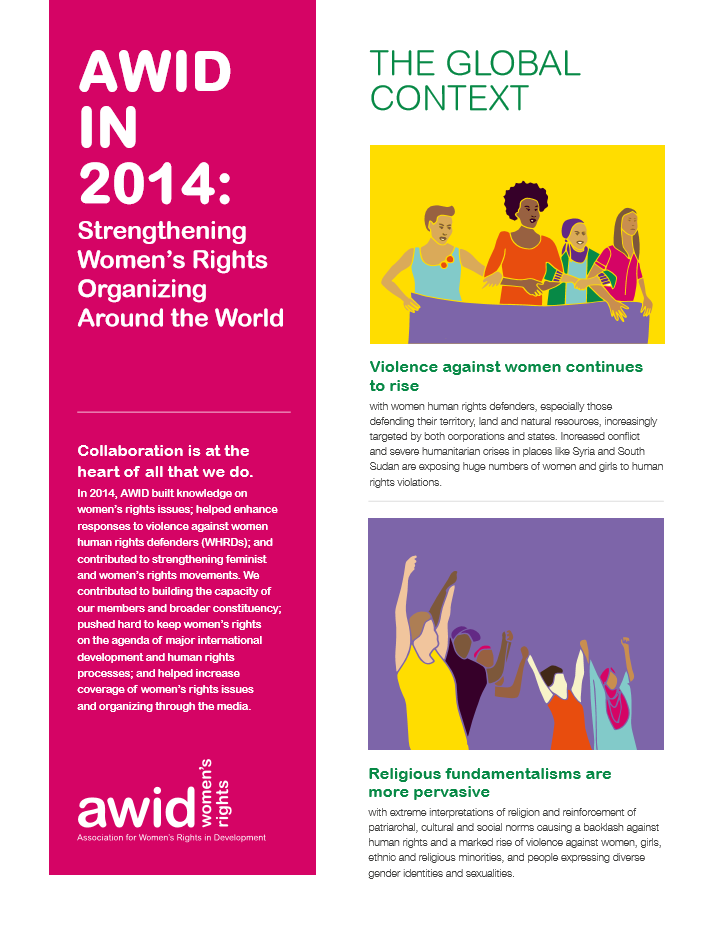
AWID is very pleased to share our 2014 Annual Report.
From building knowledge on women’s rights issues to amplifying responses to violence against women human rights defenders (WHRDs), our work last year continued to strengthen feminist and women’s rights movements across the world.
Get learn how we built the capacity of our members and broader constituency, pushed hard to keep women’s rights on the agenda of major international development and human rights processes, and helped increase coverage of women’s rights issues and organizing through the media. You'll find a panoramic sampling of our projects and some concrete numbers demonstrating our impact.
Collaboration is at the heart of all that we do, and we look forward to another year of working together to take our movements to the next level.
Despite an increasingly challenging panorama, there are important signs of hope for advancing women’s rights agendas. Women’s rights activists remain crucial in creating openings to demand structural change, sustaining their communities, opposing violence and holding the line on key achievements. And there are important opportunities to influence new actors and to mobilize greater resources to support women’s rights organizations.
In this context, strong collective action and organizing among women’s rights activists remains essential.
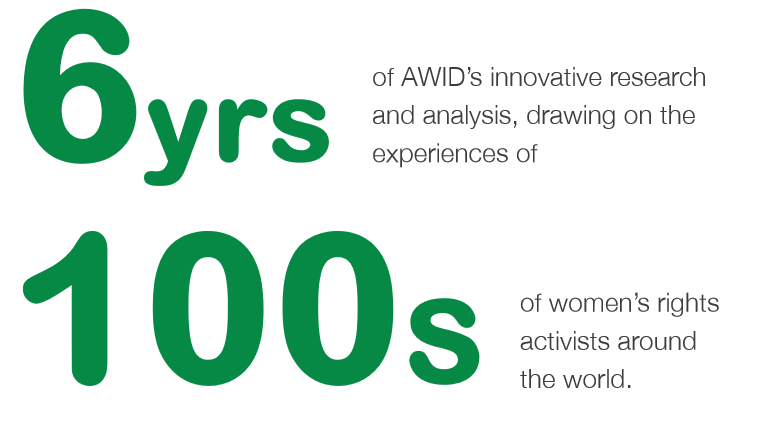
I am sincerely thrilled by AWID’s accomplishments since 1982 and hope to be able to pay at least a modest contribution to its hard work for the benefit of women and situation of gender equality.” — Aleksandra Miletic-Santic, Bosnia Herzegovina
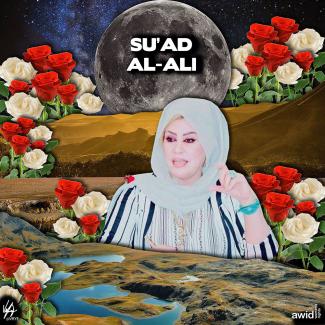
Ardente défenseure des droits des femmes et des enfants, Su’ad dirigeait Al-Weed Al-Alaiami, une organisation irakienne de défense des droits humains.
Elle a participé aux manifestations de juillet 2018 qui ont eu lieu à Bassorah et dans plusieurs autres villes irakiennes pour protester contre le chômage, réclamer des emplois et des services publics appropriés pour les citoyen-ne-s, ainsi que pour exiger l'élimination de la corruption endémique. Le 25 septembre 2018, Su’ad a été assassinée dans le quartier d’Al-Abbasiyah, dans le centre-ville de Bassorah.
Une vidéo de l’incident a montré une personne qui s'est approchée d'elle alors qu'elle montait dans sa voiture, et lui a tiré une balle dans la tête avant de pointer son arme sur son chauffeur, Hussain Hassan, qui a été blessé à l'épaule. Su’ad Al-Ali avait 46 ans et était mère de quatre enfants.
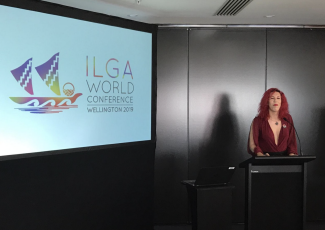
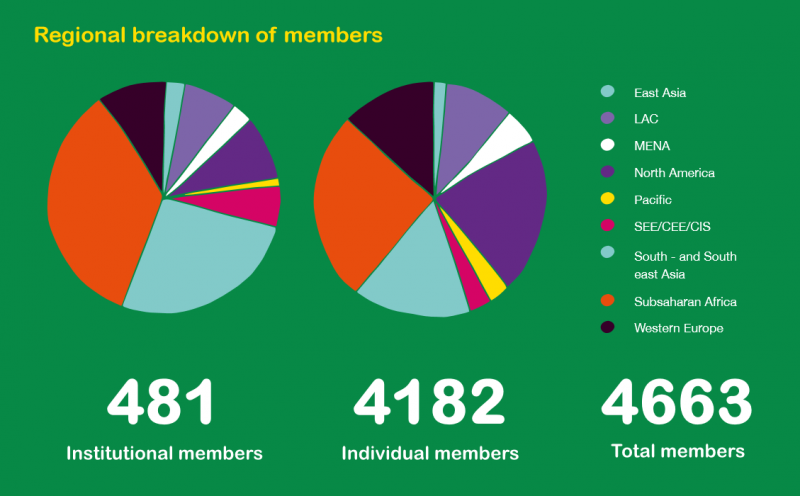
Participé en una actividad solo para afiliadxs, y lo que me conmovió en particular fue ver cómo había espacio para que todas compartieran, y que no había ningún juicio al respecto. Toda la sesión fue enérgica y vibrante.- Kirthi Jayakumar, fundadora de The Gender Security Project, India
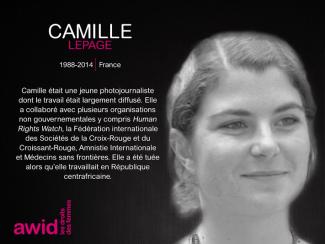
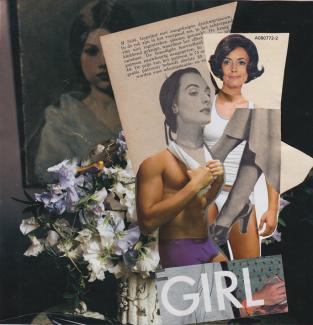
En Indonesia, la bunga [flor] está a menudo asociada a las mujeres. Esto significa que una flor también puede ser asociada a las mujeres transgénero, porque las mujeres transgénero son mujeres. Son igual de bellas, igual de fuertes, y tanto las flores como las mujeres trans no viven solo esperando ser «recogidas», sino que crecen y florecen y mueren como quieren. Esta obra es un tributo a mis amigas mujeres transgénero, en el Día Internacional de la Visibilidad Transgénero.
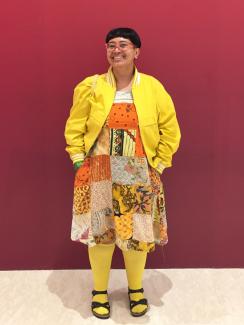
Sim, encorajamo-lo a partilhar mais sobre questões importantes para si ao responder à(s) pergunta(s) aberta(s) no final do inquérito.
AWID comenzó a preparar este informe anual en el momento en que la pandemia global empezaba a desintegrar las formas en que nos reunimos, nos organizamos y vivimos nuestras vidas. Es imposible reseñar lo que hemos hecho sin que el COVID-19 afecte nuestra evaluación.
Descargar el informe anual 2019 completo (PDF)

Es una afirmación, urgentemente necesaria, de que existen otros modos, más justos, de organizar nuestras vidas. Durante 2019, cientos de grupos compartieron con nosotrxs sus experiencias y propuestas de realidades feministas, que van desde las redes radicales de apoyo comunitario que facilitan el aborto autogestionado en América Latina y las prácticas de economías comunitarias en Indonesia y de sistemas alimentarios comunitarios en India y EEUU, hasta la reconcepción y renovación de las prácticas no perjudiciales para ritos de iniciación en Sierra Leona. Estas son las experiencias que trazarán un camino hacia una «nueva normalidad».
Una parte clave de nuestro trabajo de 2019 fue alentar estas exploraciones a través de una guía que AWID lanzó para apoyar a aquellos grupos interesados en descubrir las historias y las aspiraciones que son los componentes esenciales de las proposiciones feministas.
Mientras nos focalizamos en nuestras propuestas para un mundo diferente, también reconocemos el complejo contexto que nos rodea. A través de alianzas con el Observatorio sobre la Universalidad de los Derechos, las Feministas por un Tratado Vinculante, el Consorcio Count Me In! y otras organizaciones, AWID ha continuado resistiendo contra el poder corporativo irrestricto y contra las agendas fascistas y fundamentalistas que socavan los derechos de las mujeres y la justicia de género. En vista de las escasas posibilidades de lograr un cambio transformador a través de procesos multilaterales y de la limitada receptividad de la mayoría de los Estados, estamos redoblando nuestros esfuerzos para garantizar que los movimientos feministas, en toda su diversidad, sean financiados de forma proporcional al papel crítico que desempeñan al apoyar a sus comunidades, reclamar derechos, y responder a las crisis. En 2019, introdujimos principios y enfoques feministas para fondos innovadores como la Iniciativa Spotlight y el Fondo Igualdad, y logramos obtener recursos a través de subvenciones de fondos semilla para realidades feministas provenientes de donantes feministas.
Si miramos hacia adelante, resulta claro que el contexto requiere una transformación de nuestras estrategias de organización:
AWID se está embarcando ahora en un nuevo modelo de membresía que reduce las barreras para el acceso y pone el énfasis en las oportunidades para la participación y la conexión entre afiliadxs. Seguiremos experimentando con distintas herramientas y procesos virtuales para construir comunidad. La interacción entre movimientos continuará siendo central para nuestro trabajo. Las acciones de AWID en solidaridad con los movimientos y las identidades que sufren opresión (incluso y especialmente cuando estas quedan marginalizadas dentro de los movimientos feministas) son importantes para impulsar el cambio y brindar apoyo a los movimientos amplios e inclusivos para todas las personas.
Somos resilientes, nos adaptamos, y nos hacemos presentes para lxs demás. Y tenemos que seguir haciéndolo mejor. Gracias a todxs ustedes, que son parte del viaje junto con nosotrxs.
« Après
Après l’amour la première fois,
Nos corps et nos esprits nus
Une galerie des glaces,
Complètement désarmés, absolument fragiles,
Nous nous couchons dans les bras de l’autre
Respirant attentivement,
Avec la crainte de briser
Ces figurines en cristal. » - Fahmida Riaz
Son travail s’est confronté à de sévères critiques de la part des conservateurs, qui l’ont accusée d’utiliser des expressions érotiques et « pornographiques » dans son langage poétique.
Fahmida a finalement été mise sur liste noire et accusée de sédition en vertu de l’article 124A du Code pénal pakistanais sous la dictature de Zia-ul-Haq. Forcée à l’exil en 1981, elle a passé presque sept ans en Inde avant de retourner au Pakistan.
Dans la préface de « Badan Dareeda » (Un corps ravagé), un recueil de poèmes publié en 1974, elle écrit :
La splendeur de Fahmida résidait dans sa défiance de toute logique ou toute catégorie particulière de genre, nation, religion ou culture. Elle refusait d’être mise dans le rôle d’une « femme poète », brisant les définitions traditionnelles de la poésie féminine, des concepts et des thématiques (variant entre conscience politique, corps, culture, désir, religion, foyer), et renversant les inhibitions assignées à son genre.
« Il faut que vous compreniez que la culture ne peut avoir d’essence. Les cultures changent, circulent entre elles, formant de nouvelles cultures. La culture est née de cette façon. Il n’y a pas de conflits de cultures. »
Fahmida a écrit plus de 15 livres de poésie et de fiction, dont son poème ‘Taaziyati Qaraardaaden’ («Résolutions de condoléances» en anglais) qui pourrait servir d'hommage approprié à sa vie et à son héritage et de collection de poèmes (Apna Jurm To Saabit He «Mon crime est prouvé») publié en 1988 durant son exil.
Fahmida Riaz est née à Meerut, en Inde, le 28 juillet 1946 et est décédée le 21 novembre 2018 à Lahore, au Pakistan.
Linda Porn est une autre héroïne de l'organisation syndicale féministe et de l'activisme des travailleur·euses du sexe au niveau national (en Espagne) et transnational.
Originaire du Mexique, elle vit en Espagne depuis les années 2000. Elle est travailleuse du sexe, militante, mère célibataire et artiste multidisciplinaire.
Puisant dans ces différentes identités, elle utilise la performance, l'art vidéo et le théâtre pour rendre visibles les luttes aux intersections du transféminisme, du travail du sexe, de la migration, du colonialisme et de la maternité. Elle combine l'art et le travail du sexe tout en prenant soin de sa fille en tant que mère célibataire.
Linda appartient également à des groupes de travailleur·euses du sexe qui luttent pour leurs droits, comme le syndicat OTRAS et CATS Murcia. Elle a également cofondé le groupe 'Madrecitas' - qui rend visible et dénonce la violence institutionnelle raciste contre les familles migrantes. Violence à laquelle elle et sa fille ont été soumises en tant que travailleuse du sexe et mère célibataire migrante.
Ne ratez pas son travail artistique ici!
Le Forum de l’AWID s’articulera autour de 6 sujets interconnectés. Ces ‘points d’ancrage’ sont centrés sur les réalités féministes.